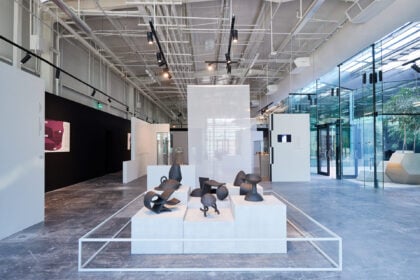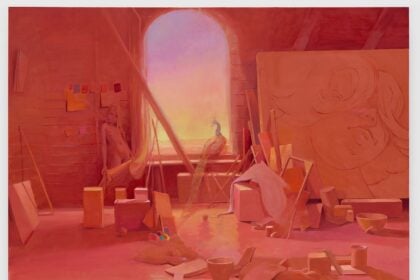

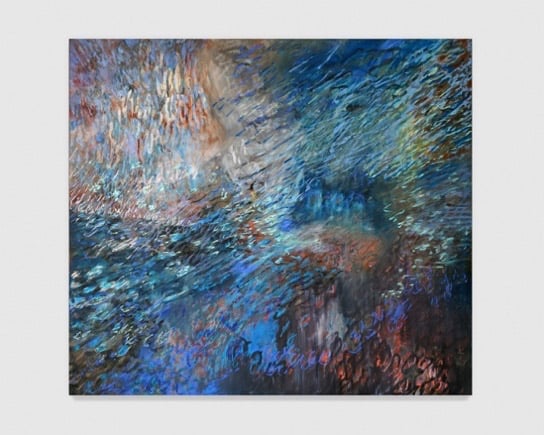
Pace Gallery will present land marks, a group exhibition of new and recent works by 17 artists that examines how selfhood takes shape in relation to the environments people inhabit. Staged at the gallery’s Los Angeles flagship, the presentation foregrounds rooms, landscapes, and sites of gathering as repositories of memory that both shape and reflect the self.
Curated by Joshua Friedman, a Vice President at Pace with long-standing experience in the Los Angeles art community, the exhibition considers space not only as a physical category but also as an emotional and psychological terrain. The curatorial premise argues that understanding the self often entails understanding the places that have held it—domestic interiors, communal venues, and transitional sites where presence, absence, and passage leave traces over time.
Exhibition Focus and Themes
land marks explores the duality of the “mark,” conceived here as both monumental and fragile—deliberate as well as incidental. Across the works on view, the artists trace the mutual inscription between individuals and their surroundings: the marks made on the world and the impressions the world leaves on the body and mind. The exhibition frames identity as a surface on which experiences are “etched,” suggesting that the boundaries between inner and outer worlds are porous and continuously rewritten.
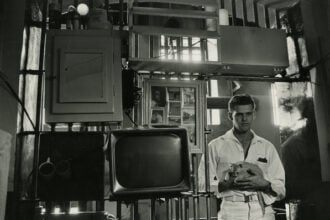


The show assembles more than 25 works with a strong emphasis on painting. The roster includes Jarvis Boyland, Chioma Ebinama, Janiva Ellis, Jake Grewal, Loie Hollowell, Patricia Iglesias Peco, Li Hei Di, Sophia Loeb, Sarah Martin-Nuss, Marina Perez Simão, Nathlie Provosty, Anne Rothenstein, Kate Spencer Stewart, Reika Takebayashi, Salman Toor, Janaina Tschäpe, and Shiwen Wang. Together, these practices interrogate interiority and exteriority, memory and temporality, and embodied perception—how environments accumulate meaning and how that accretion shapes the way people live, remember, and move through the world.
Highlights and New Works
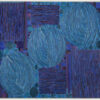
Several new commissions and first-time presentations anchor the exhibition. Newly created paintings by Loie Hollowell, Li Hei Di, and Marina Perez Simão—artists in Pace’s program—advance distinct languages of abstraction to bring questions of inner and outer experience to the forefront. Their works situate abstraction as a tool for charting the boundary between bodily perception and the larger environments that condition it. In parallel, a new, previously unexhibited painting by London-based artist Sophia Loeb investigates the sensorial dimensions of space and landscape through gestural, undulating forms.
Artists working from Los Angeles—among them Jarvis Boyland, Patricia Iglesias Peco, and Kate Spencer Stewart—probe the emotional and psychological complexities of interiority. Their contributions offer layered readings of presence, vulnerability, and transformation grounded in everyday architectures. From New York, Janiva Ellis, Sarah Martin-Nuss, and Janaina Tschäpe examine how temporality, memory, and embodied perception alter the experience of place, arguing that space is perpetually reconfigured by recollection and movement.
A Curatorial Framework of Reciprocity
The exhibition positions “land” less as a fixed territory than as an evolving index of relations. In this framework, rooms once called home, collective sites of becoming, and open landscapes function as accumulators of meaning. The marks people leave—on floors, walls, paths, and shared spaces—are read alongside the traces that those sites impart in return. This reciprocity animates the presentation: it suggests that to “know oneself” requires reading both outward inscriptions and inward residues that persist across time and context.
While painting anchors the selection, the presentation’s logic is multidisciplinary and geographic, bridging artists at different career stages and from Los Angeles, New York, the United Kingdom, Japan, Brazil, and Greece. The curatorial through-line allows both figurative treatments and speculative abstractions to coexist, mapping a composite terrain where architecture, atmosphere, and memory intersect. The result is a cross-section of practices that treat space as a living medium—one that receives, records, and returns the gestures made within it.
Context within Pace’s Program
The Los Angeles presentation extends Pace’s broader program, which pairs historical stewardship with contemporary practices. The gallery represents influential artists and estates and has built decades-long relationships with figures central to movements such as Abstract Expressionism and Light and Space. Alongside these legacies, Pace invests in the careers of contemporary artists including Torkwase Dyson, Loie Hollowell, Robert Nava, Adam Pendleton, and Marina Perez Simão. This dual commitment—to historical depth and contemporary inquiry—frames land marks as part of an ongoing exploration of how artists map perception, form, and experience.
Under current leadership, the gallery emphasizes collaboration with peer galleries and nonprofit organizations and supports scholarship through Pace Publishing, an imprint focused on research-driven projects that introduce new voices to the art-historical record. Public installations, performances, philanthropic initiatives, and other interdisciplinary programs are aligned with an artist-first ethos. The present exhibition sits within that constellation, drawing attention to practices that probe how space is felt, remembered, and reimagined.
Pace maintains a global footprint with multiple locations in the United States, Europe, and Asia, including two galleries in New York and a flagship space in Los Angeles, as well as galleries in London, Geneva, Berlin, Hong Kong, Seoul, and Tokyo. The Los Angeles venue hosting land marks is part of a sustained engagement with the West Coast, where the gallery has championed perception-driven practices and dialogues around space, light, and environment.
Reading the Works
Across the roster, artists approach space as both subject and method. Some render spatial fields as near-bodily—gradients, undulations, and traces that echo interior states and sensorial thresholds. Others situate figures within rooms or landscapes that bear the weight of past events, staging tensions between presence and loss through color, composition, and surface. Still others concentrate on the temporal dimension of perception—how time alters what space discloses and how memory redraws the map long after a moment has passed. Seen together, these approaches construct a layered atlas in which the “land” of land marks is part architecture, part atmosphere, part archive.
Rather than fix a singular meaning to place, the exhibition accumulates instances—marks—through which viewers might consider how environments become entries in both personal and collective ledgers. The works suggest that space is never neutral: it registers the gestures and movements that occur within it and, in turn, informs how those gestures are felt, recalled, and understood. In this sense, land marks reads the world as a palimpsest of interactions, where identity and environment continuously co-author each other.
Venue and dates: Pace Gallery, 1201 South La Brea Avenue, Los Angeles
November 1, 2025 to January 17, 2026.
Opening reception: Friday, November 7 at 6 PM