

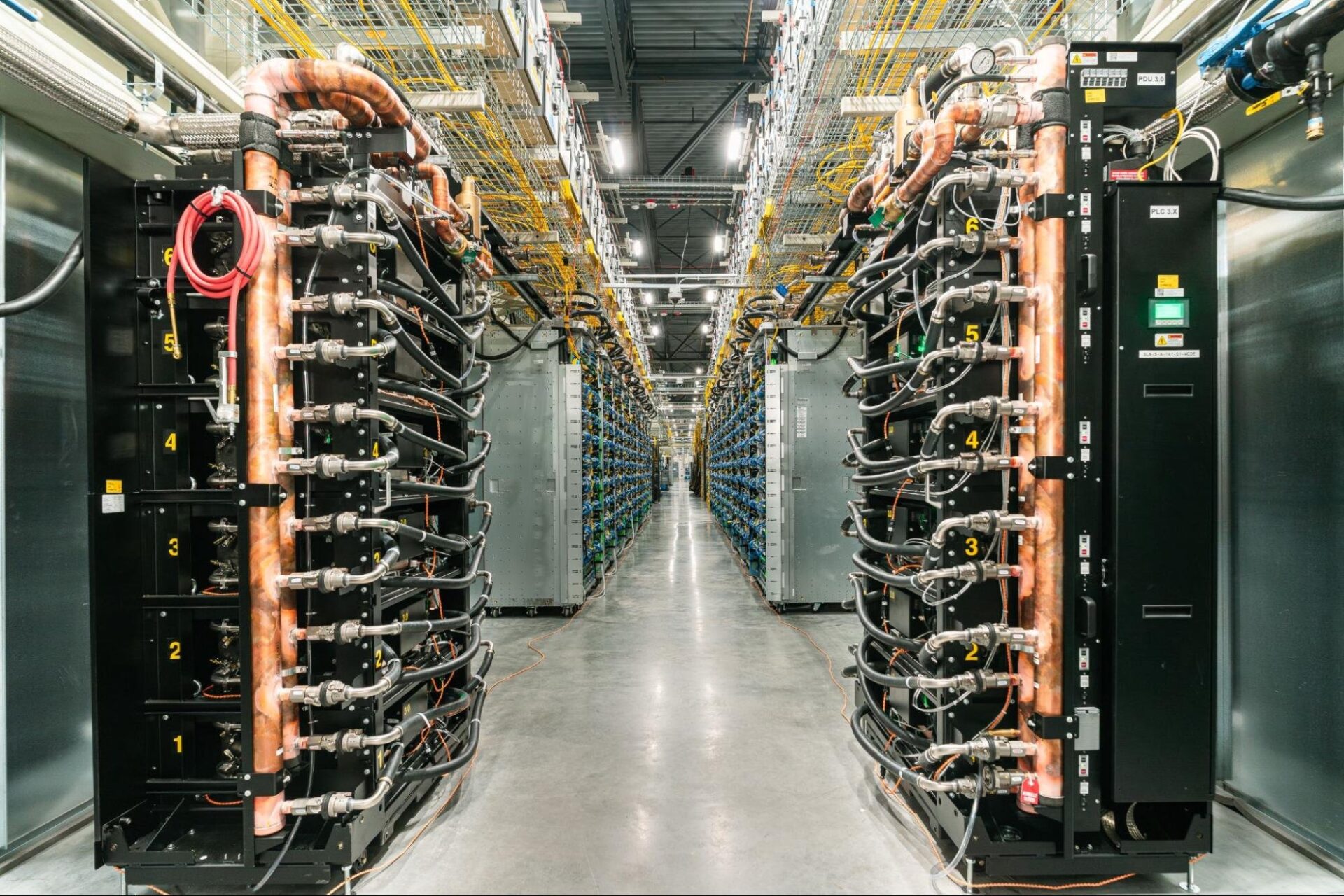

The language we use for technology is often misleading, designed to tame, to domesticate. We are told Google has a new “chip.” This is a comforting, familiar word. A chip is a small, inanimate square of silicon, something you can hold in your hand.
This supercomputer is built in a modular fashion. A single physical host contains four Ironwood chips, and a rack of these hosts forms a “cube” of 64 chips. To scale further, these cubes are connected by a dynamic Optical Circuit Switch (OCS) network, which allows the system to link up to 144 cubes into the 9,216-chip “superpod”. This pod-scale architecture is not just for size; it provides 42.5 FP8 ExaFLOPS of compute power and access to 1.77 Petabytes of shared high-bandwidth memory.
To understand what Google has built, one must first dispense with the idea of a discrete, individual product. The true unit of computation is no longer the processor; it is the data center itself. Ironwood, Google’s seventh-generation Tensor Processing Unit (TPU), exists as a “superpod”—a single, cohesive supercomputer that interconnects 9,216 of these new chips. This colossal architecture is not cooled by simple fans but by an industrial-scale “advanced liquid cooling solution,” a circulatory system essential to dissipate the immense waste heat generated by its 10-megawatt power draw.



For context, 10 megawatts is the approximate power consumption of a small city or a large industrial factory. This is the sheer, “brute force” scale of modern artificial intelligence. AI is not an ethereal, abstract “cloud.” It is a physical, heavy industry that consumes raw materials (in this case, planet-scale energy) to produce a new, invisible commodity: synthetic intelligence. The Ironwood pod, with its 9,216-chip configuration, is the new engine of this industry, a liquid-cooled behemoth designed for one purpose: to think at a scale that was, until now, unimaginable.
This immediately presents the central conflict of the 21st century’s defining technology. This level of power consumption, scaled across an entire industry, is inherently unsustainable. This 10-megawatt pod is a technological marvel, but it is also a profound environmental liability. The rest of the story of AI is an attempt to grapple with this single, foundational fact.
The Age of Inference
For the last decade, the primary challenge of AI has been “training.” This is the high-cost, time-intensive process of teaching a model, feeding it the entirety of the internet to “learn” language, logic, and reasoning. But that era is ending. The new frontier is the “age of inference”—the constant, high-volume, real-time thinking the model performs after it has been trained.
Every time an AI answers a question, generates an image, or “proactively retrieves and generates data,” it is performing inference. Ironwood is, by Google’s own admission, its “first accelerator designed specifically for inference”. This signals a critical market shift. The battle is no longer just for building the largest models, but for efficiently running the “high-volume, low-latency AI inference and model serving” that will power the coming wave of “AI agents” like Google’s own Gemini.
This is where Google’s true strategy is revealed. Ironwood is not a product to be sold; it is a foundational component of Google’s “AI Hypercomputer”. This is not just hardware, but a vertically integrated system where the hardware (Ironwood TPUs and the new Arm-based Axion CPUs) is “co-designed” with a proprietary software stack.
This co-designed stack is Google’s strategic moat. While it offers “out-of-the-box” support for open-source frameworks like PyTorch to lure developers in, the stack is truly optimized for Google’s own JAX ecosystem.
- The XLA (Accelerated Linear Algebra) compiler acts as the crucial translator, converting high-level code into hyper-efficient instructions that run directly on the TPU silicon. This provides broad, “out-of-the-box” optimization, translating code from frameworks like JAX and PyTorch into hyper-efficient instructions for the TPU silicon.
- The new “Cluster Director” for Google Kubernetes Engine (GKE) is the orchestrator, a piece of software that can manage the 9,216-chip superpod as a single, resilient unit. This software provides topology awareness for intelligent scheduling, simplifying the management of massive-scale clusters and enabling resilient, self-healing operations that can route around interruptions.
- And native support for vLLM maximizes inference throughput, a critical component for serving models in the “age of inference”. This support is crucial for the “age of inference,” as vLLM uses highly efficient memory management techniques to maximize throughput and allows development teams to switch workloads between GPUs and TPUs with minimal changes.
For the past decade, NVIDIA’s dominance has been built not just on its GPUs, but on its proprietary CUDA software platform—a “moat” that developers are locked into. Google’s AI Hypercomputer is a direct attempt to build a rival, walled garden. By offering superior performance-per-dollar only to those who commit to its stack, Google is positioning itself to become the fundamental utility for the AI economy. It is not selling the cars (like NVIDIA); it aims to sell the electricity that powers them.
The Kingmaker and the Multi-Cloud War
The ultimate validation of this strategy arrived in late 2025. Anthropic, a leading AI lab and primary rival to OpenAI, announced a landmark expansion of its partnership with Google, committing to use its TPU infrastructure, including the new Ironwood, at a staggering scale: “up to one million TPUs”.
This is not a casual investment. It is a “tens of billions of dollars” deal that will bring “well over a gigawatt of capacity” online for Anthropic by 2026. This one deal serves as the ultimate justification for Google’s decade-long, multi-billion-dollar bet on custom silicon. Anthropic’s stated justification for this massive commitment was “price-performance and efficiency,” a clear signal that Google’s co-designed, vertically integrated stack can offer a compelling economic alternative to NVIDIA’s dominance.
But this story has a critical twist—one that reveals the true power dynamics of the AI industry. Anthropic is not exclusively Google’s. In its own announcement, Anthropic was careful to note that Amazon Web Services (AWS) remains its “primary training partner and cloud provider”. This AWS partnership is built around “Project Rainier,” a massive cluster utilizing hundreds of thousands of Amazon’s own Trainium2 accelerators. The company is pursuing a “diversified approach,” strategically playing Google’s TPUs, Amazon’s Trainium chips, and NVIDIA’s GPUs against one another.
This is not indecision; it is a brilliant act of survival. Leaked data shows that Anthropic’s compute costs on AWS alone were consuming as much as 88.9% of its revenue. The AI labs’ very existence depends on driving down this astronomical cost. By forcing this bidding war, analysts estimate Anthropic is likely securing its compute—the single most expensive part of its business—at a massive 30-50% discount. By publicly partnering with both Google and Amazon, Anthropic has made itself the “kingmaker.” It is forcing the cloud giants into a bidding war, leveraging its status as a “prize” AI lab to have the hyperscalers effectively subsidize its enormous compute bills.
This dynamic has-beechanged the market. The ultimate winner will not be the one with the fastest chip, but the one with the best ratio of computation-to-power-to-cost. “Performance-per-watt” is no longer a simple environmental slogan; it is the primary strategic and economic battleground of the entire industry.
The New Silicon Titans: An Uneasy Oligarchy
The launch of Ironwood is a direct shot at NVIDIA, but the battlefield is crowded. The AI arms race is being fought by a new oligarchy of silicon titans, a small handful of corporations with the capital and technical expertise to build the “shovels” for this new gold rush.
- The Incumbent King (NVIDIA): NVIDIA’s Blackwell-generation GPUs, the B100 and B200, and their predecessor, the H100, remain the industry standard. Their dominance is protected by the deep software moat of CUDA, which most AI researchers and developers are trained on.
- The Pretenders (The Hyperscalers & AMD):
- Amazon (AWS): The most mature custom-silicon operation among the cloud providers, AWS employs a dual-chip strategy: “Trainium” for cost-effective training and “Inferentia” for high-speed, low-cost inference. This dual-chip strategy is bound together by the AWS Neuron SDK, the software layer designed to optimize PyTorch and TensorFlow workloads for its custom silicon.
- Microsoft (Azure): To service the massive needs of its key partner, OpenAI, Microsoft has developed its own “Maia 100” AI accelerator, co-designing it for the workloads of ChatGPT and GPT-4. One of the largest processors built on TSMC’s 5nm node, Maia 100 is a 500W-700W chip that, like its rivals, is co-designed with its own software stack to port models from frameworks like PyTorch.
- AMD: NVIDIA’s traditional rival, AMD, competes directly on performance with its Instinct MI300X accelerator, which matches new-generation chips on key metrics like memory capacity (192GB).
This corporate arms race is driven by three simple factors:
- Cost: Designing your own chip is the only way to escape NVIDIA’s “mid 70%” profit margins and premium pricing.
- Supply: It provides strategic independence from the chronic NVIDIA GPU shortages that have bottlenecked the entire industry.
- Optimization: It allows for the kind of “performance-per-watt” edge that Google is chasing—a chip perfectly “co-designed” for its specific software and cloud workloads.
The cloud giants do not need to kill NVIDIA. They simply need to create a viable, in-house alternative that is good enough. This commoditizes the market, gives customers a choice, and forces NVIDIA to lower its prices, saving the hyperscalers billions on their own capital expenditures.
The scale of this consolidation is difficult to comprehend. The major tech giants, including Google, Meta, Amazon, and Microsoft, are set to spend as much as $375 billion in a single year on the construction of these data centers and the AI hardware to fill them. The barrier to entry for this new market is staggering. The tech giants are set to spend as much as $375 billion this year on data center construction and hardware. This is not democratization. This is the consolidation of power. The AI revolution will not be decided by a clever algorithm in a garage; it will be decided by the five corporations that can afford to build these 10-megawatt brains.
The 2025 AI Accelerator Showdown
Google Ironwood (TPU v7): Type: ASIC. Max HBM (Memory): 192 GB HBM3e. Max Mem. Bandwidth: 7.4 TB/s. Key Scaling Architecture: 9,216-chip Superpod (9.6 Tb/s ICI). Primary Use Case: Inference & Training.
NVIDIA Blackwell B200: Type: GPU. Max HC (Memory): 192 GB HBM3e. Max Mem. Bandwidth: 8 TB/s. Key Scaling Architecture: NVLink 5 (1.8 TB/s). Primary Use Case: General-Purpose Training & Inference.
AMD Instinct MI300X: Type: GPU. Max HBM (Memory): 192 GB HBM3. Max Mem. Bandwidth: 5.3 TB/s. Key Scaling Architecture: 8-GPU Ring. Primary Use Case: General-Purpose Training & Inference.
AWS Trainium / Inferentia 2: Type: ASIC. Max HBM (Memory): (Trn) N/A / (Inf2) 32 GB HBM. Max Mem. Bandwidth: (Inf2) N/A. Key Scaling Architecture: AWS Neuron SDK / Cluster. Primary Use Case: Split: Training (Trn) / Inference (Inf).
Microsoft Maia 100: Type: ASIC. Max HM (Memory): 64 GB HBM2E. Max Mem. Bandwidth: N/A. Key Scaling Architecture: Ethernet-based Fabric. Primary Use Case: Internal (OpenAI) Training & Inference.
The Shadow of the Chip War
The corporate battle between Google, NVIDIA, and Amazon is being fought in the shadow of a much larger, more consequential conflict: the geopolitical “Chip War” between the United States and China.
The entire modern world, from our smartphones to our most advanced military systems, is built on a breathtakingly fragile supply chain. The “Silicon Shield” of Taiwan, home to TSMC, produces “roughly 90% of the world’s most advanced semiconductors”. This concentration of manufacturing in the Taiwan Strait, a “critical geopolitical flashpoint,” is the single greatest vulnerability of the global economy.
In recent years, the U.S. has weaponized this dependency, implementing “sweeping export controls” to “deprive China of… advanced chips” in an attempt to slow its technological and military rise. In response, China is “pouring billions into its chip-building ambitions,” accelerating its “military-civil fusion strategy” in a desperate quest for “semiconductor self-sufficiency”.
This quest is personified by state-championed companies like Huawei. Its work on developing indigenous AI chips, such as the Ascend 910C, poses a direct challenge to NVIDIA’s dominance within China. This vertical integration, combined with China’s “military-civil fusion strategy,” makes it increasingly difficult for Western-allied nations to identify which parts of the Chinese supply chain are safe to engage with.
This global instability creates an existential risk for Big Tech. A military conflict in Taiwan could halt the AI industry overnight. The chronic NVIDIA shortages are a minor inconvenience compared to a supply chain cataclysm.
Viewed through this lens, Google’s Ironwood is more than a competitive product; it is an act of “corporate sovereignty”. By designing their own custom silicon, companies like Google, Amazon, and Microsoft “mitigate supply chain risks” and “reduce reliance on third-party suppliers”. They own the intellectual property. They are no longer dependent on a single company (NVIDIA) or a single, vulnerable region (Taiwan). They can diversify their manufacturing partners, ensuring their business model survives a geopolitical shock.
The corporate arms race and the geopolitical one are now two sides of the same coin. The massive investments by Google and Amazon are, in effect, implementing U.S. industrial policy. They are creating the industrial backbone of a Western-allied technology sphere (the “Chip 4” alliance) and establishing a “technological distance” that China’s indigenous solutions, like Huawei’s Ascend 910C, are racing to close.
The Unbearable Weight of Computation
This brings us back to the 10-megawatt pod. The AI arms race, fueled by corporate and geopolitical ambition, is now confronting its own physical limits. The environmental price of “brute force” scaling is staggering.
Anthropic’s deal for Google’s TPUs is for “over a gigawatt” of power. That is the equivalent of 100 Ironwood pods running simultaneously, or the entire output of a full-scale nuclear power plant, dedicated to a single company. And that company is just one of many.
The carbon footprint of a single “thought” is becoming alarmingly clear.
- Training a single large AI model can emit over 626,000 pounds of CO2, “roughly equivalent to the lifetime emissions of five American cars”.
- A single query to an AI like ChatGPT uses “about 100 times more energy than a typical Google search”.
- The total energy footprint of the generative AI industry is “growing exponentially” and is already “equivalent to that of a low-income country”.
It is not just energy. Data centers are also “devouring” a more finite resource: water. They require “vast amounts of water for cooling,” placing an enormous strain on local resources, often in already water-scarce regions. Industry estimates suggest the average data center already uses 1.7 liters of water for every kilowatt-hour of energy consumed.
The industry, including Google, attempts to deflect this crisis by boasting of “efficiency” gains. Google claims Ironwood is “nearly 30x more power efficient than our first Cloud TPU from 2018”. This, however, is a red herring. It is a clear example of the Jevons Paradox: technological efficiency gains, when applied to a desirable resource, do not decrease consumption. They increase it by making that resource cheaper and more accessible.
Ironwood’s efficiency does not solve the environmental problem; it accelerates it. It makes it economically and technically feasible to build even larger models and handle even more queries, pushing total energy consumption ever higher. The industry’s race to “prioritize speed over safety and ethics”—a rush that has led to documented failures like Google’s own biased Gemini outputs—is creating a planet-scale ethical crisis, with the environmental damage as a massive, off-balance-sheet externality.
This ethical crisis stems from the potential for AI systems to embed and amplify human biases, threaten human rights, and manipulate public opinion through misinformation. The U.S. Government Accountability Office has noted that even with monitoring, these systems, when rushed to market, remain susceptible to attacks that generate factually incorrect or biased content. This “arms race” dynamic, where corporate goals for rapid deployment override safety protocols, creates a foundational tension between innovation and responsibility.
Coda: The Suncatcher in the Sky
Google’s engineers are not blind to this paradox. They see the energy consumption graphs. They understand that the “brute force” scaling of AI has a terrestrial ceiling. Their proposed solution is the perfect, surreal metaphor for the entire industry.
It is a “long-term research moonshot” called “Project Suncatcher”.
The plan is to launch AI data centers into space. These “compact constellations of solar-powered satellites,” equipped with Google’s TPUs and connected by “free-space optical links,” would be placed in a “dawn-dusk sun-synchronous low-earth orbit”. There, they would receive “near-continuous sunlight,” solving the power problem, while the vacuum of space would offer a solution for cooling without water.
This is not fantasy. Google has already tested its Trillium-generation TPUs in a particle accelerator to simulate the radiation of low-Earth orbit, and the chips “survived without damage”. A prototype launch in partnership with Planet Labs is planned for early 2027.
Project Suncatcher is a tacit admission of terrestrial failure. It is a confession that the industry’s chosen path—the path powered by 10-megawatt brains like Ironwood—is unsustainable on planet Earth. The project’s goal, in Google’s own words, is to “minimise impact on terrestrial resources” because the “environmental burden” of their own roadmap is becoming too high to bear.
This is the ultimate expression of the technological sublime. The AI arms race, in its quest for godlike intelligence, is creating a future where the computational cost of our own curiosity is so great that we must literally escape our own planet to sustain it. The Ironwood chip is the engine. The Hypercomputer is the factory. The Chip War is the shadow. And Project Suncatcher is the escape hatch—a desperate, brilliant, and terrifyingly logical leap into the void.
This logic, however, is not without its own profound technical and economic challenges. Skeptics are quick to point out that space is not a magical solution for cooling; it is the “best heat insulator that exists”. A space-based data center would not cool passively but would require massive, complex radiators comparable in size to its solar panels. These systems would also have to contend with the extreme cost of maintenance and the constant bombardment of radiation that ruins processors—hurdles that make this “escape hatch” a gambit of truly astronomical proportions.