


An Artist in Constant Motion
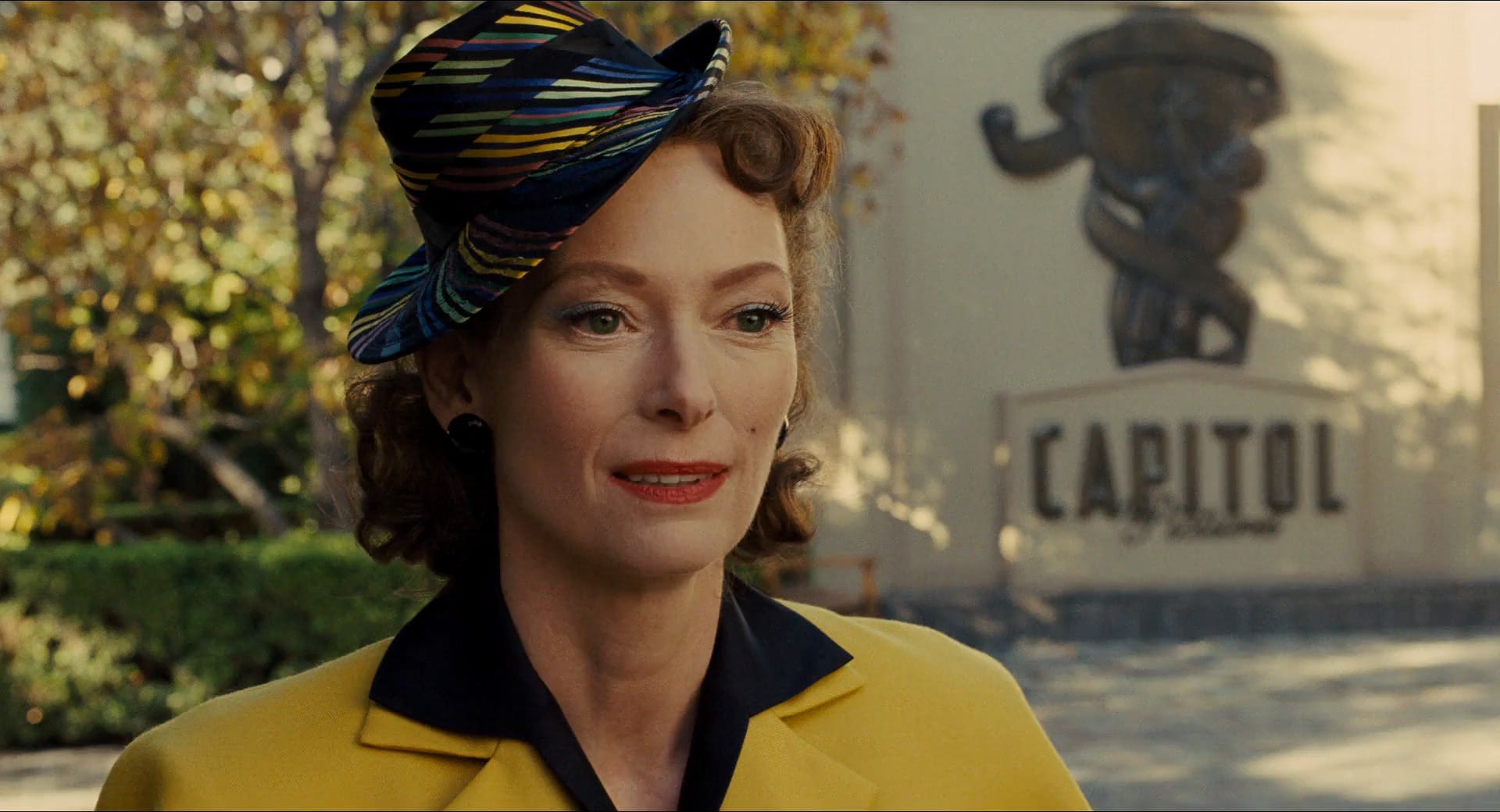
To define Tilda Swinton is to embrace a contradiction. She is an artist in a state of perpetual motion, an unclassifiable force whose career resists retrospective because it is never truly in the past. This is perhaps best captured by the title of her major exhibition at Amsterdam’s Eye Filmmuseum, “Ongoing”.1 It is not a look back, but a living constellation of the creative partnerships that fuel her work, a testament to a process that is never finished.2 In 2026, she will return to the stage for the first time in over three decades, reprising her 1988 role in Man to Man for the Royal Court’s 70th anniversary, another forward-looking gesture that defies the conventions of a veteran performer’s career trajectory.13
Swinton is an Academy Award winner, a fashion icon, a performance artist, and a blockbuster star, yet none of these labels suffice.23 She prefers the term “performer” to “actor,” a subtle but crucial distinction that encompasses her improvisational, co-authorial, and autobiographical work.26 Hailed by The New York Times as one of the greatest actors of the 21st century, she has built a career on a foundation of paradox: the aristocrat who became a communist, the avant-garde muse who conquered Hollywood, and the global star who remains fiercely rooted in the Scottish Highlands.24 This is the story of how Katherine Matilda Swinton crafted an identity not from the fixed lineage she was born into, but from a lifelong commitment to collaboration, transformation, and the radical belief that the self is not a destination, but a continuous, ongoing journey. The title of her exhibition is more than a name; it is her artistic thesis, suggesting an identity rooted in the process of creation and connection, not in a static collection of past achievements.2
The Reluctant Aristocrat
The Weight of Lineage
To understand Tilda Swinton’s relentless pursuit of transformation, one must first grasp the immutability of her origins. She was born in London on November 5, 1960, into a patrician Scottish military family whose lineage is one of the oldest in Scotland, traceable back 35 generations to the 9th century.28 Her eldest recorded ancestor swore allegiance to Alfred the Great in 886.28 Her father, Major-General Sir John Swinton, was the former head of the Queen’s Household Division and Lord Lieutenant of Berwickshire, a figure embodying centuries of tradition, establishment, and what Swinton herself calls “the owning class”.30 It was a world of immense historical weight, a pre-written script of conformity and expectation.


Swinton’s disavowal of this heritage is central to her identity. When confronted with her family’s ancient history, she has remarked, “All families are old. It’s just that mine have lived in the same place a long time and happened to write things down”.28 This statement is a deliberate act of demystification, a refusal to be defined by the past. From an early age, she characterized herself by not playing the part, joking that her parents realized early on she “was not going to marry a duke”.28
Education as Rebellion
Her formal education became the first arena for this rebellion. At the age of 10, she was sent to board at West Heath Girls’ School, where one of her classmates was the future Princess of Wales, Diana Spencer.28 She loathed the experience, describing boarding school as “brutal” and “a very efficient way of keeping you at a remove from life”.28 It was at West Heath that a formative moment crystallized her opposition to the patriarchal order. After hearing the headmaster at her brothers’ school tell the boys, “You are the leaders of tomorrow,” she returned to her own school to be told, “You are the wives of the leaders of tomorrow”.28 This starkly defined the limited, gendered role prescribed for her, a role she would spend her life dismantling.
Cambridge and Political Awakening
Her intellectual and political awakening took place at the University of Cambridge, where she studied Social and Political Sciences and English Literature at New Hall, graduating in 1983.23 In a definitive act of rebellion against her aristocratic background, she joined the Communist Party.27 Cambridge was also where she immersed herself in experimental theatre, participating enthusiastically in student productions that would lay the groundwork for her performing career.27
Following university, she had a brief, year-long tenure with the prestigious Royal Shakespeare Company from 1984 to 1985.27 However, she quickly found herself out of sympathy with the company’s ethos, which she perceived as male-dominated, and has since expressed a profound disinterest in the conventions of live theatre, finding it “really boring”.30 Her path was not to be one of interpreting classics on stage but of forging a new, unwritten role for herself in the world of performance. Her entire artistic persona can be seen as a direct, lifelong reaction against the fixed identity she was born into. Her fascination with fluidity and escape from historical determinism is not an abstract interest, but a deeply personal project of self-creation, a subversion of her own origin story.
The Jarman Years: Forging an Identity
The Foundational Partnership
After leaving the RSC, Swinton found her artistic home not in an institution, but in a person. In 1985, she met the avant-garde filmmaker, artist, and gay rights activist Derek Jarman, a meeting that would define the first chapter of her career and instill in her an artistic and ethical framework that endures to this day.36 Their nine-year collaboration began with her feature film debut in Caravaggio (1986) and spanned eight films, including the politically charged The Last of England (1988), the queer historical drama Edward II (1991), and the philosophical biopic Wittgenstein (1993).36
The Jarman Ethos
Working with Jarman was Swinton’s film school. He did not operate with the hierarchical structure of a traditional film set; instead, he fostered a collective, collaborative environment where Swinton was a trusted co-author from the beginning.4 This experience shaped her lifelong preference for making work with friends, a process she describes as being fueled by the belief that “the relationship is the battery”.12 Jarman’s work was also fiercely political, a direct artistic confrontation with the repressive, homophobic currents of Margaret Thatcher’s Britain, particularly Section 28, a law prohibiting the “promotion of homosexuality”.39 He taught her that art could be a form of activism and that a filmmaker could wrap the cultural center around them rather than chasing it.41 This collaborative ethos, built on trust and shared authorship, became her operational DNA, a model she would seek to replicate throughout her career in a quiet challenge to the traditional power dynamics of Hollywood.4
A Turning Point: Grief and Reinvention
The partnership came to a tragic end with Jarman’s death from an AIDS-related illness in 1994.36 This was a period of profound loss for Swinton; at 33 years old, she had attended the funerals of 43 friends who had died from AIDS.26 The death of her primary collaborator left her at a creative crossroads, unsure if it was possible to work with anyone again in the same way.4
Her response was not to seek another director but to invent a new form of performance. This led to the creation of The Maybe, a piece of living art in which she lies asleep, seemingly vulnerable, inside a glass vitrine in a public gallery.26 First performed at London’s Serpentine Gallery in 1995, the piece was a direct response to the grief of the AIDS epidemic.26 Tired of sitting beside her dying friends, she wanted to “give a living, healthy, sleeping body to a public space”.26 It was an exploration of a “non-performed but alive” presence, a cinematic gesture where the audience could choose their distance, scrutinizing her up close or viewing her from afar like a figure on a screen.26 The Maybe marked her reinvention, a turn towards a more personal, autobiographical form of performance that would continue to inform her work for decades.
Orlando and the Androgynous Ideal
International Breakthrough
If the Jarman years forged her artistic identity, it was Sally Potter’s 1992 film Orlando that broadcast it to the world.43 Based on Virginia Woolf’s 1928 novel, the film tells the story of an English nobleman who lives for 400 years without aging and, midway through, transforms into a woman.43 The role was a perfect vessel for Swinton’s otherworldly, androgynous presence, and her remarkable performance catapulted her to international recognition.43
Embodying Fluidity
Orlando was more than a role; it was the ultimate expression of Swinton’s personal and artistic project. The character’s journey is a literal escape from the confines of time, history, and gendered inheritance—the very forces that had defined her own aristocratic upbringing.23 Swinton played both the male and female Orlando with an innate understanding of the character’s core identity, which remains constant despite the external transformations. The film culminates in one of her most iconic moments on screen: in the present day, Orlando sits under a tree and stares directly into the camera for a full 20 seconds, her enigmatic gaze holding the entire weight of a 400-year saga of change and survival.46 The film was a critical and commercial success, praised as a bold, intelligent, and visually magnificent adaptation that presaged contemporary conversations about gender identity by decades.47
The Birth of a Fashion Icon
The film’s aesthetic and its profound exploration of identity cemented Swinton’s status as a cultural and fashion icon. Her striking, unconventional beauty and rejection of traditional femininity made her a muse for avant-garde designers.49 Viktor & Rolf famously based their entire Fall 2003 collection on her, sending an army of Swinton doppelgängers down the runway.49 She has cultivated long-standing, deeply personal relationships with designers, most notably Haider Ackermann, whose clothes she feels “in company” with, as well as houses like Lanvin and Chanel.49 Her fashion sense, like her acting, is a form of performance. She has stated that she was more influenced by the sharp tailoring and embroidered finishes of her father’s military uniforms and the androgynous glamour of David Bowie than by conventional evening dresses.49 Orlando was the moment her personal philosophy and public image fused into a singular, powerful statement. The film’s success validated her entire anti-establishment, gender-subversive project, granting her the cultural capital to build a career entirely on her own uncompromising terms.
Conquering Hollywood on Her Own Terms
A Strategic Entry
Following the success of Orlando, Swinton began a careful and strategic navigation of mainstream cinema. Roles in films like The Beach (2000) and Vanilla Sky (2001) introduced her to a wider audience, but this was not a case of “selling out”.31 Instead, it was an expansion of her artistic canvas, an experiment in applying her unique sensibilities to the larger-scale productions of Hollywood.
The Blockbuster Anomaly
Her forays into major franchises demonstrated a remarkable ability to retain her artistic integrity within the most commercial of frameworks. As Jadis, the White Witch in The Chronicles of Narnia series (2005-2010), she brought a genuinely chilling, icy regality to a beloved children’s fantasy, creating a villain who was both terrifying and mesmerizing.55 Later, she entered the Marvel Cinematic Universe, taking on the role of the Ancient One in Doctor Strange (2016) and Avengers: Endgame (2019).55 In a subversive piece of casting, she played a character traditionally depicted as an elderly Tibetan man, imbuing the sorcerer with a transcendent, minimalist composure and a quiet, relaxed authority that defied the blockbuster stereotype of the all-powerful master.26 She treats these commercial projects as experiments, seeing the established archetypes not as constraints but as templates to be filled and subtly altered from within, smuggling her avant-garde sensibilities onto the world’s biggest screens.26
The Oscar Win
The culmination of her successful integration into the Hollywood ecosystem came in 2008 at the 80th Academy Awards.24 Swinton won the Oscar for Best Supporting Actress for her role as Karen Crowder, a ruthless and unraveling corporate lawyer, in Tony Gilroy’s legal thriller Michael Clayton (2007).24 Her performance was lauded as “subtly chilling,” a masterful portrayal of an amoral executive consumed by ambition and panic.59 Swinton herself found the role unusual for its naturalism, a departure from her more stylized work.41 The win was a pivotal moment, cementing her status as one of the most respected and versatile performers in the industry, one who could move seamlessly between the arthouse and the mainstream, excelling in both without compromise.24
The Art of Transformation
Master of Disguise
Tilda Swinton’s career can be read as a long-form performance art piece on the theme of identity itself. She is a true chameleon, but her transformations are more than just makeup and costumes; they are profound acts of embodiment that challenge the audience’s assumptions about gender, age, and humanity.49 Each radical disguise is a practical demonstration of her core artistic belief in the non-existence of a fixed self, proving that identity is fluid and performative.
Case Studies in Transformation
Several roles stand out as pinnacles of her transformative power. In Bong Joon-ho’s dystopian thriller Snowpiercer (2013), she is unrecognizable as Minister Mason, a grotesque caricature of authoritarian power.55 With a piggy nose, large prosthetic teeth, a severe wig, and fake war medals, Mason is a clownish and pathetic figure, a blend of historical monsters like Margaret Thatcher and Benito Mussolini.61 The inherent ridiculousness of her appearance is key to the character, a walking loudspeaker for a brutal regime whose power is as fragile as her appearance is absurd.61
For Wes Anderson’s The Grand Budapest Hotel (2014), she underwent five hours of makeup each day to become Madame D., an 84-year-old, wealthy dowager.62 Despite having very little screen time, her melodramatic and clingy performance is utterly memorable, setting the entire film’s madcap plot in motion and symbolizing the lost, pre-war world the film mourns.63
Perhaps her most radical transformation came in Luca Guadagnino’s 2018 remake of Suspiria. In a feat of performative layering, she not only played the mysterious dance director Madame Blanc but also, secretly, the elderly male psychiatrist Dr. Jozef Klemperer, a role initially credited to a fictional actor named Lutz Ebersdorf.55 Her commitment was absolute; makeup artist Mark Coulier revealed she wore a “weighty set of genitalia” under her costume to fully feel and embody the male character.55 While the film polarized critics, Swinton’s dual performance was a breathtaking display of her fearless dedication to dissolving the boundaries of identity.64
The Psychological Core: We Need to Talk About Kevin
Swinton’s transformations are not only physical. In Lynne Ramsay’s harrowing psychological drama We Need to Talk About Kevin (2011), she delivered one of the most acclaimed performances of her career as Eva Khatchadourian, the mother of a teenage son who commits a school massacre.27 The film is told entirely from Eva’s fractured, grief-stricken perspective, and Swinton’s performance is a fearless exploration of maternal ambivalence, guilt, and enduring, inexplicable love.67 It is a wrenching psychological portrait that required her to be on screen for nearly every moment of the film, carrying its immense emotional weight.67 The role earned her BAFTA and Golden Globe nominations and cemented her reputation as an actress of unparalleled bravery and emotional depth.31
A Constellation of Collaborators
Beyond Jarman
After Derek Jarman’s death, Tilda Swinton did not search for a replacement but instead began to build a new constellation of creative families. Her career model, based on loyalty and repeated collaboration, is a direct continuation of the ethos she learned in her formative years.36 Each of her primary collaborators allows her to explore a different facet of her own artistic identity, making her filmography a curated dialogue with different artistic minds rather than a simple succession of roles.
Wes Anderson (The Stylist)
Her five-film collaboration with Wes Anderson—spanning Moonrise Kingdom (2012), The Grand Budapest Hotel (2014), Isle of Dogs (2018), The French Dispatch (2021), and Asteroid City (2023)—engages her precision and wry wit.24 Her roles in his meticulously composed, theatrical worlds are often small but always impactful cameos.63 Whether as the austere “Social Services” in Moonrise Kingdom, the art critic J.K.L. Berensen in The French Dispatch, or the scientist Dr. Hickenlooper in Asteroid City, she brings an incisive sensibility that melds perfectly with Anderson’s restrained, stylized form of acting.63
Luca Guadagnino (The Sensualist)
Her long and deeply personal partnership with Italian director Luca Guadagnino activates her sensuality and profound emotional depth. Their relationship began with his 1999 debut, The Protagonists, and has since produced the lush family drama I Am Love (2009)—a project they developed together for over a decade—the erotic thriller A Bigger Splash (2015), and the horror epic Suspiria (2018).54 Their work together is a feast for the senses, exploring themes of desire, passion, and identity against visually ravishing backdrops, with fashion and aesthetics playing a central narrative role.44
Jim Jarmusch (The Poet of the Night)
With American independent director Jim Jarmusch, Swinton explores her philosophical, otherworldly quality. Across their four films together—Broken Flowers (2005), The Limits of Control (2009), The Dead Don’t Die (2019), and most notably, the vampire romance Only Lovers Left Alive (2013)—they have crafted a body of work defined by a cool, nocturnal, and poetic sensibility.54 As the ancient, wise vampire Eve in Only Lovers Left Alive, Swinton embodies a timeless grace and intelligence, perfectly at home in Jarmusch’s moody, music-infused world of brilliant artist-poet-scientists.44
The Woman Behind the Persona
Life in the Highlands
For all her otherworldly screen presence, Tilda Swinton’s life is deliberately grounded. She resides in Nairn, a town in the Highland region of Scotland, far from the epicenters of the film industry.27 This choice is not an escape from her work but the very foundation that makes it possible. It allows her to protect the creative freedom and collaborative spirit she values above all. Her personal life has also defied convention. She had a long-term relationship with the Scottish artist and playwright John Byrne, with whom she had twins, Honor Swinton Byrne and Xavier Swinton Byrne, in 1997.31 Since 2004, her partner has been the German-New Zealand visual artist Sandro Kopp.24 She has described their arrangement as a happy, unconventional family of friends.81 Her daughter, Honor Swinton Byrne, has followed in her footsteps, starring alongside her mother in Joanna Hogg’s acclaimed films The Souvenir and The Souvenir Part II.56 These life choices reflect her childhood ambition, which she once confessed was not fame, but simply “a house by the sea, a kitchen garden, children, some dogs and lots of friends,” and the opportunity to “make work with friends”.82
Art Beyond the Screen
Swinton’s artistic practice extends far beyond film. Her performance piece The Maybe has become a recurring, unannounced event, appearing at the Museo Barracco in Rome (1996) and the Museum of Modern Art in New York (2013) after its London debut.25 She has also engaged in curatorial work, organizing a photography exhibition inspired by Orlando at the Aperture Foundation in 2019.47 Her collaborations with French fashion historian Olivier Saillard have resulted in a series of acclaimed performance pieces that use clothing to explore memory and history.2 These activities are not hobbies but integral parts of a holistic artistic project where the boundaries between art and life are deliberately blurred.
A Queer Sensibility
In 2021, Swinton clarified that she identifies as queer, explaining that for her, the term relates to sensibility rather than sexuality.27 This identification is a fitting encapsulation of her life’s work. To be queer, in this sense, is to exist outside of rigid categories, to question norms, and to embrace fluidity as a state of being.83 It is a sensibility that has informed every aspect of her career, from her androgynous aesthetic and gender-bending roles to her collaborative methods and her defiance of the traditional star system.83
The Ongoing Conversation: Art as a Living Practice
Swinton’s philosophy of collaboration and continuous creation is being given its most complete expression in “Tilda Swinton – Ongoing,” a major exhibition running from September 2025 to February 2026 at Amsterdam’s Eye Filmmuseum.1 Described not as a retrospective but as a “living constellation” of her ideas and friendships, the exhibition focuses on her active role as a co-author.1
Swinton has invited eight of her closest artistic partners to create new and present existing works. The collaborators include Pedro Almodóvar, Luca Guadagnino, Joanna Hogg, Derek Jarman, Jim Jarmusch, Olivier Saillard, Tim Walker, and Apichatpong Weerasethakul.2 The works are deeply personal, exploring themes of memory, nature, and friendship.3 Highlights include a multimedia reconstruction of her 1980s London apartment with Joanna Hogg, a new short film and sculpture by Luca Guadagnino, and a photo series by Tim Walker shot at her family home in Scotland.2 In a multi-day performance with Olivier Saillard, Swinton will bring to life garments from her personal collection, film costumes, and family heirlooms.2 The exhibition is a physical embodiment of her belief that art is not a static product but a living, breathing conversation between trusted friends.
Forever ‘Ongoing’
Tilda Swinton is an artist defined by paradox: the aristocrat who embraced rebellion, the avant-garde muse who became a blockbuster star, the public icon who lives a fiercely private life. Her career is a powerful testament to an uncompromising vision, proving that it is possible to navigate the heights of the film industry without sacrificing an ounce of artistic integrity. She has built her life’s work not on a singular ambition but on a constellation of deep, enduring creative relationships.
As she prepares for projects like the “Ongoing” exhibition and her return to the London stage in 2026 to reprise her 1988 role in Man to Man, it is clear that her career has no final act.13 There is only the continuous process of exploration, conversation, and reinvention. Tilda Swinton’s legacy is not just in the characters she has played, but in the revolutionary way she has played the game. She has not just succeeded within the film industry; she has fundamentally expanded our understanding of what a performer can be, cementing her place as one of the most singular and influential artists of her generation.