

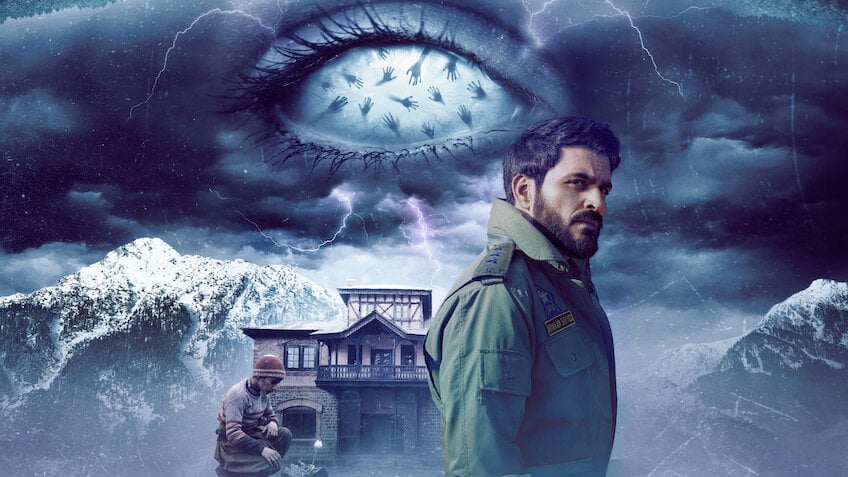

A new supernatural thriller, “Baramulla,” is scheduled for its premiere on Netflix. The film uses the “hauntingly beautiful” valleys of Kashmir, covered in mist and snow, as the main backdrop for a story that promises a “chilling cinematic experience.”
The film is defined as a genre-blending mix of supernatural thriller, mystery, drama, and intense psychological tension. The plot unfolds in the town of Baramulla, a place described as an environment where “myths and whispers blend with reality,” and where the community’s peace is shattered.
The narrative, directed by Aditya Suhas Jambhale, is set in motion by an alarming event: the mysterious disappearance of a child. This initial event, reportedly occurring during a magic show, triggers a “chilling chain of events” that disturbs the valley.



The Plot: A Dual Investigation (The Valley and the Home)
The story of “Baramulla” operates on two simultaneous fronts: a criminal investigation into a series of disappearances and an unsettling paranormal event taking place inside the protagonist’s home.
The Case: The Disappearance of the Children
The film follows DSP Ridwaan Shafi Sayyid, a police officer described as “tough,” “disciplined,” and “tormented by his own demons.” The character is played by actor Manav Kaul.
Ridwaan is transferred or summoned to the town of Baramulla with the specific task of investigating a disturbing series of child disappearances that has shaken the local community.
As Ridwaan delves deeper into the case, he becomes entangled in a complex “web of secrets.” The investigation forces him to navigate local folklore, hidden truths, and the underlying “socio-political tensions” of the region. He soon confronts a darkness that seems to defy all logical explanation.
The Horror: The Presence in the Home
Parallel to the official investigation, a more personal and intimate horror plot unfolds. DSP Ridwaan moves to Baramulla with his family, which includes his wife Gulnaar (played by Bhasha Sumbli) and their two children, Noorie (Arista Mehta) and Ayaan (Rohaan Singh).
The family settles into an “old and decrepit house,” where they almost immediately begin to experience a series of “strange and inexplicable events.” These paranormal phenomena manifest in specific sensory ways: the family hears “phantom footsteps” at night, unexplained whispers, and feels “unseen presences.” One of the most disturbing details is the smell of “a dog that isn’t there,” reported by both the wife and the children.
Gulnaar is the first to become convinced that there is an “unsettling presence” or an “invisible entity” in the house. The family’s life descends into a disturbing spiral where the line between reality, hallucination, and the supernatural begins to blur.
Although Ridwaan, in his role as a logical police officer, initially “ignores his family’s anxieties,” the “growing evidence” within his own home forces him to confront the terrifying possibility that the two cases—the missing children in the valley and the presence in his house—might be connected.
The Creative Team and the Director’s Vision
“Baramulla” reunites several key members of the creative team behind the political thriller Article 370, marking a deliberate pivot from that genre toward supernatural horror.
The Director and the Genre Transition
The film is directed by Aditya Suhas Jambhale, who also co-wrote the screenplay. The writing team includes Aditya Dhar and Monal Thaakar.
The film is produced by Jyoti Deshpande of Jio Studios, along with Aditya Dhar and Lokesh Dhar of B62 Studios. This is the second collaboration between Netflix and the production houses following the romantic comedy Dhoom Dhaam.
A Statement Against “Loud Horror”
In statements about the film, the creative team has emphasized a focus on psychological depth over superficial scares. Director Aditya Suhas Jambhale explained that while the story begins as a mystery thriller, “it slowly pulls you into something far more emotional and psychological.”
Jambhale defined the film’s central theme as “fear, not just the kind that lurks in the dark, but the kind that lives within us, the fear of what the mind refuses to accept.”
This vision is shared by the lead actor, Manav Kaul. Kaul described the film’s approach as “not a loud horror.” Instead, he stated that it is “the kind that creeps up on you, where silence feels heavier than sound.”
Jambhale has also expressed his opinion on the Indian film industry, highlighting the need to “set trends rather than follow them.” He has pointed out a trend in the industry of replicating formulas that have worked, such as horror comedies, instead of taking creative risks. The director has suggested that many film failures are due to “weak writing” and that “most of the problems are on paper.”
By praising films like Kantara for pushing the “folklore and that cultural aspect” of the country into the mainstream, Jambhale has positioned “Baramulla” as an attempt to approach the horror genre in a more substantive way. The stated goal is to “redefine the Indian thriller genre” and explore horror through “human emotion” and trauma.
The Setting as an Entity: Kashmir
A recurring central element in the film’s description is the importance of its setting. The creative team has been emphatic that the location is more than just a backdrop.
Aditya Suhas Jambhale stated: “Kashmir is not just the setting; it is a living, breathing character that shapes every moment and every mystery.” The director expressed his hope that the audience “feels the pulse of the valley and the humanity at the heart of this journey.”
The landscape of Kashmir, often portrayed for its picturesque beauty, is used in this narrative to inspire feelings of “loneliness and terror.”
This connection to the location is deeply personal for the lead actor, Manav Kaul, who is originally from the town of Baramulla. Kaul mentioned that the script felt like “a sign from the universe to tell the stories of the valley with honesty” and sincerity.
Credits and Cast
The main cast of “Baramulla” is led by Manav Kaul in the role of DSP Ridwaan Shafi Sayyid. He is joined by Bhasha Sumbli, known for her performance in The Kashmir Files, who plays Gulnaar, Ridwaan’s wife.
The roles of the couple’s children, Noorie and Ayaan, are played by Arista Mehta and Rohaan Singh (also credited as Singh Rohaan), respectively.
The supporting cast includes Neelofar Hamid (as Zainab), Mir Sarwar (as Ansari), Vikas Shukla (as Shaukat), Masoom Mumtaz Khan, Kiara Khanna, Ashwini Koul, and Shahid Latief.
As for the technical and creative team, in addition to direction by Aditya Suhas Jambhale, the screenplay was co-written by Jambhale, Aditya Dhar, and Monal Thaakar. Production is handled by Jyoti Deshpande (Jio Studios), along with Aditya Dhar and Lokesh Dhar (B62 Studios). The team is completed by Arnold Fernandes as director of photography and Shivkumar V. Panicker in editing. The film’s global distribution is handled by Netflix.
Availability
The film premieres on Netflix on November 7.