

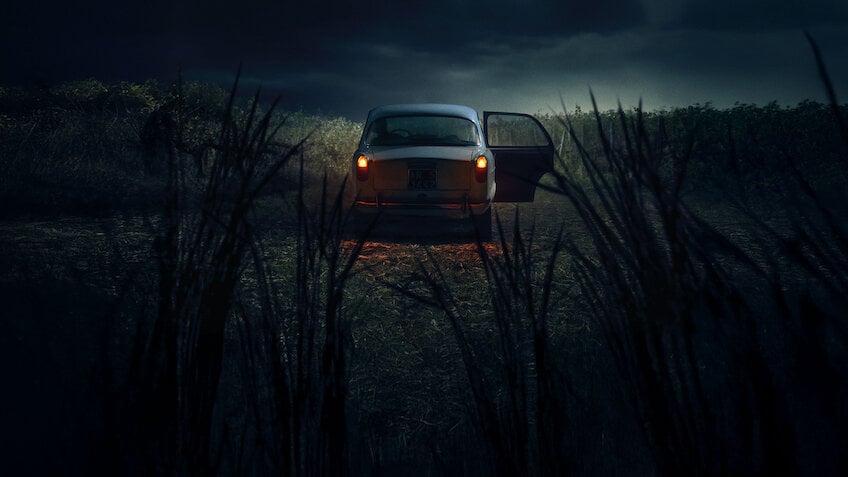


In true Ryan Murphy style, Netflix brings us another serial killer series, this time from Italy and revisiting the real-life case. He’s not Ed Gein or Jeffrey Dahmer, but this Italian series promises to follow in the footsteps of those shows and become a new favorite for true crime fans.
The hills surrounding Florence are a landscape of timeless beauty, a postcard of cypress trees, olive groves, and vineyards that has inspired artists for centuries. For a long time, its secluded paths and hidden clearings were also a refuge for young lovers, a place for intimacy far from prying eyes. But for one long, dark period, this idyllic Tuscan countryside became the hunting ground for an anonymous figure who would transform romance into terror and leave an indelible scar on Italy’s collective psyche.
The killer’s modus operandi was methodical and chillingly consistent. His victims were always young couples, surprised in the intimacy of their cars in isolated locations. With the exception of one double homicide of two German tourists, the victims were established couples, often engaged with wedding plans, and belonged to a lower-middle-class social background. One more detail added to the baffling pattern: many of the victims, both men and women, worked in some capacity in the textile industry.


The weapon was invariably the same: a .22 caliber Beretta pistol, whose bullets would become the ballistic signature connecting a series of seemingly disparate crimes over the years. But the violence did not end with the gunshots. The killer used a knife to inflict ritualistic mutilations on the female victims, excising the pubic area in several of the attacks, an act of brutality that magnified the terror and pointed to a deep, dark psychopathology.
The first double homicide, however, was not immediately recognized as the inaugural act of a serial killer. It was classified as a crime of passion, and the female victim’s husband, Stefano Mele, was arrested, tried, and convicted. This seemingly definitive legal resolution turned out to be the foundational error of the entire investigation, a mistake that left an open wound, personified by the victim’s son, a six-year-old boy who was sleeping in the back seat of the car and who, decades later, would remain tormented by the memory of seeing his mother dead.
By closing the case, authorities unwittingly created a gap of several years during which the real killer could operate undetected, allowing him to perfect his method and sow panic. Only much later, when the .22 caliber Beretta shells from that first crime were rediscovered and ballistically linked to subsequent attacks, did investigators realize the story had begun much earlier than they thought and that their starting point had been a false trail.
The calm was broken years later. The same .22 caliber Beretta reappeared in Borgo San Lorenzo to kill Pasquale Gentilcore and Stefania Pettini, this time adding the macabre signature of post-mortem mutilation. From then on, the Monster’s shadow spread across the countryside in a relentless sequence. In Calenzano, Susanna Cambi and Stefano Baldi fell. In Montespertoli, Antonella Migliorini and Paolo Mainardi were murdered in an attack that seemed to be interrupted. The violence even reached two German tourists, Horst Wilhelm Meyer and Jens-Uwe Rüsch, in Galluzzo. The terror continued in Vicchio with Pia Rontini and Claudio Stefanacci, and again in Baccaiano, with another couple, Paolo Mainardi and Antonella Migliorini. The final act of this bloody saga took place in San Casciano, where French tourists Jean-Michel Kraveichvili and Nadine Mauriot were murdered in their tent, with the female victim suffering the same ritualistic mutilation that had become the killer’s hallmark.
A Labyrinth of False Leads and Dead Ends
The hunt for the man the press dubbed “Il Mostro di Firenze” (The Monster of Florence) stretched for nearly two decades, becoming a swamp of false leads, contradictory theories, and judicial errors. The investigation was a reflection of the chaos and fear the killer had unleashed, a labyrinth where both investigators and the public repeatedly lost their way.
The initial investigations focused on the so-called “Sardinian trail,” a circle of Sardinian immigrants linked to the first double homicide. Names like Francesco Vinci appeared in the files time and again, being arrested, interrogated, and released on multiple occasions, but a definitive charge against them could never be solidified. The Sardinian trail became a recurring theme, a dead end to which investigators returned every time a new crime left them without clues.
The investigation’s focus would change drastically with the appearance of Pietro Pacciani, a farmer from Mercatale Val di Pesa, a rough man with a violent past. Pacciani had already been convicted of killing a man he caught with his fiancée, a fact that made him an ideal suspect in the eyes of investigators and a society desperate for a face to embody evil.
His arrest gave way to one of Italy’s most spectacular courtroom dramas. Pacciani was tried and sentenced to multiple life terms for seven of the eight double murders. However, in a stunning turn, he was acquitted on appeal. The legal saga took yet another twist when the Supreme Court of Cassation overturned the acquittal and ordered a new trial, a proceeding that would never take place.
Pacciani was found dead in his home under mysterious circumstances, prompting a homicide investigation that only added more fuel to the fire of speculation. His death left an unanswered question, although some investigators were convinced Pacciani would have confessed sooner or later—not out of remorse, but from a desire to claim authorship of crimes that, in his twisted logic, granted him terrible prominence.
Pacciani’s death did not close the case; it simply opened a new and strange door. Attention shifted to his associates, Mario Vanni and Giancarlo Lotti, known as the “compagni di merende” (the snacking buddies). Lotti, in a confession that changed the course of the trial, implicated himself, Vanni, and the late Pacciani in four of the double homicides. His testimony led to the definitive convictions of Vanni to life in prison and Lotti to 26 years.
Judicially, it was a conclusion, but for many, it was deeply unsatisfactory. The persistent focus on Pacciani and his circle reveals an underlying dynamic in the investigation: the search for a convenient monster. They were the “perfect culprits.” Rural, uneducated men with coarse manners, they fit an archetype of provincial evil that was easier for society to process than more complex theories pointing to professionals, cults, or even a “pista nera” (black trail) linked to the far-right and secret services, framed within the “strategy of tension” Italy experienced in those years. Justice was not just pursuing an individual, but a preconceived idea of evil, a simple narrative for an incomprehensible horror.
Despite the convictions, the investigation into the Monster of Florence officially remains open, a testament to the doubts and shadows that still loom over the case.
The Fear of a Generation
The impact of the Monster of Florence’s crimes transcended the pages of the crime blotter to infiltrate the social fabric of an entire region. It was a collective trauma that altered customs, sowed distrust, and left a legacy of fear that endures today.
The killer attacked a universal rite of youth: the search for intimacy, the private moment of a couple in love. Overnight, the act of “appartarsi” (parking in a secluded spot) ceased to be a romantic gesture and became a mortal risk. Fear redefined the behavior of an entire generation, which began to avoid the isolated places that were once synonymous with freedom. This change in habits was the most tangible manifestation of a terror that had become omnipresent, even stimulating debate about the need to grant young people more privacy at home to avoid the dangers outside.
The media played a crucial role in building the legend. They were the ones who coined the term “Mostro di Firenze,” and with their incessant coverage, they helped forge a “mythology of evil” around the figure of the unknown killer. The Monster became more than just a criminal; he was a specter, a boogeyman lurking in the national consciousness, generating a climate of suspicion where anyone could be the culprit.
The story provoked “rabia, paura, disgusto” (rage, fear, disgust) and is still considered a “storia maledetta” (cursed story) because of the injustice and pain it generated, especially for the victims’ families.
This case was, in many ways, a decisive moment for Italian culture, marking its entry into the modern era of media-driven true crime. Before the Monster, serial killers were seen as a largely American phenomenon. His reign of terror brought that horror home, and the symbiosis between the killer, the media, and the public created a new form of national obsession that would set a precedent for future cases. Amid the media circus surrounding the suspects, the real human cost was often forgotten. Figures like Renzo Rontini, father of victim Pia Rontini, dedicated the rest of their lives to a relentless search for justice, a poignant reminder of the personal tragedy that lies at the heart of this national saga.
The Monster Reexamined: A New Cinematic Inquiry
Decades after the last crime, the story of the Monster of Florence continues to fascinate and disturb. Now, Netflix presents “The Monster of Florence,” a miniseries that promises to be the definitive exploration of one of the darkest chapters in Italian history.
The project is in the hands of creators Stefano Sollima and Leonardo Fasoli, a creative team with impeccable credentials in the crime genre, responsible for hits like “Gomorrah” and “Suburra: Blood on Rome.” Their involvement guarantees a serious and stylistically potent approach. The official synopsis describes a four-episode limited series meticulously based on “actually occurring events, direct testimonies, procedural documents, and journalistic investigations.” The tagline, “Tutto terribilmente vero” (All terribly real), underscores an unwavering commitment to factual authenticity.
The key to the series lies in its bold narrative choice. Instead of trying to solve a mystery that has eluded justice for decades, the production will focus on exploring the story from a different perspective: “our story explores precisely them, the possible monsters, from their point of view.”
This decision is much more than a simple dramatic device; it is a direct commentary on the nature of the case. The real investigation was a parade of suspects, men whose lives were consumed by the accusation. By adopting their perspectives, the series does not seek to create a whodunit, but rather a drama about the nature of suspicion, judicial fallibility, and public condemnation. It transforms the case’s greatest weakness—the absence of a definitive answer—into its main narrative strength.
The series, therefore, does not offer solutions but opens questions, restoring a multiplicity of partial truths and immersing the viewer in the gray area between guilt and innocence. This strategy culminates in the series’ unsettling thesis: “Because the monster, in the end, could be anyone.” It is a direct reflection of the ambiguity that still defines the case and an invitation for the viewer to confront the idea that evil does not always have a clear, defined face.
To bring this vision to life, the production has assembled a cast of emerging actors, including Marco Bullitta, Valentino Mannias, Francesca Olia, Liliana Bottone, Giacomo Fadda, Antonio Tintis, and Giordano Mannu, a deliberate choice to prioritize authenticity over star power. The series is produced by The Apartment and AlterEgo, stamps of quality in contemporary drama.
The Revelation
“The Monster of Florence” does not pretend to offer easy answers to an enigma that has resisted all attempts at a solution. Its promise is to immerse the viewer in the depths of one of Italy’s most disturbing mysteries, not to find the killer, but to explore the unsettling questions that still echo in the hills of Florence.
The series, which promises to be one of the television events of the year, premieres on Netflix on October 22.