


In a suburban neighborhood in Ocala, Florida, at the Quail Run apartment complex, life moved along with the apparent normalcy of any close-knit community. Families, children playing outdoors in a vacant lot, and the daily frictions of living together painted a familiar picture. However, a seemingly minor dispute centered on that very playground became the epicenter of a chain of events that would devastate the community and expose deep social fissures.
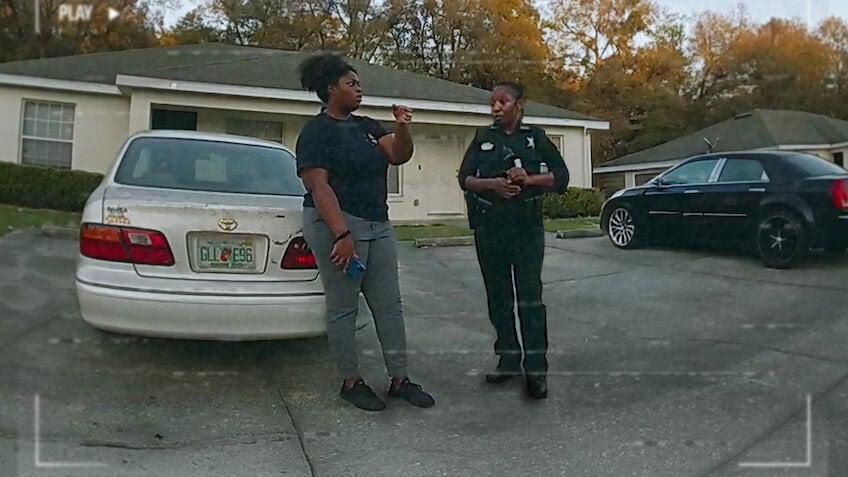
A new and acclaimed documentary, “The Perfect Neighbor,” directed by the award-winning filmmaker Geeta Gandbhir, delves into the heart of this tragedy. The production is not a traditional narrative but an immersive and raw reconstruction of the facts, told almost entirely through a unique lens: that of police body cameras. The film gives us an unfiltered look at how an everyday conflict can escalate into a fatal act of violence, revealing the consequences of prejudice, fear, and systemic failures.
The documentary poses a fundamental question: How do you go from living next to someone who is just your neighbor to raising a weapon and committing such a horrible act? This question serves as the film’s narrative core, guiding the viewer through the anatomy of a tragedy that resonates far beyond the confines of a small Florida neighborhood.


Chronicle of a Growing Hostility
The documentary chronicles the escalating conflict between Ajike “AJ” Owens, a 35-year-old Black mother, and her white neighbor, 58-year-old Susan Lorincz. What began as a neighborhood dispute transformed into a pattern of relentless harassment. Over a period of more than two years, authorities responded to at least half a dozen calls related to the feud between the two, establishing a documented history of prolonged tension.
The film details Lorincz’s behavior, who made constant calls to the police to complain about Owens’s children and other neighborhood kids playing in a field near her home. This harassment included the use of racial slurs, a fact Lorincz herself later admitted to detectives. The hostility was so well-known in the community that the children referred to her as “the Karen,” a popular term to describe a white woman who uses her privilege to impose her will.
The documentary’s narrative culminates on the fatal night, meticulously reconstructed through official recordings. The sequence of events shows Lorincz confronting Owens’s children as they played. During the altercation, Lorincz threw a skate at them, hitting one of the children in the foot, and also brandished an umbrella at another.
When the children told their mother what happened, Ajike Owens, unarmed and accompanied by her 10-year-old son, went to Lorincz’s door to confront her. Lorincz’s response was to fire a single shot from a .380 caliber pistol through her own door, which was closed and deadbolted. The bullet struck Owens in the upper chest, mortally wounding her. The documentary captures the immediate chaos and pain, including the heartbreaking cry of Owens’s son, “My mom’s been shot!” and a neighbor’s desperate attempt to perform CPR.
A Cinematography of Evidence
The most distinctive and radical feature of “The Perfect Neighbor” is its formal approach. The film is constructed almost entirely from official archival material, forgoing talking-head interviews, narrators, or dramatic reenactments. The primary sources are police body camera recordings, 911 calls, interrogation room videos, and footage from patrol car dashboard cameras.
This stylistic choice reflects a clear filmmaking philosophy on the part of director Geeta Gandbhir: total viewer immersion. Her goal was to “just live in the police body camera footage” so the audience could feel “embedded within the community” and draw their own conclusions without the guidance of a voice-over. This “show, don’t tell” method trusts the audience’s intelligence and empathy to process the events as they unfolded. The director felt that because it was “institutional footage,” the public would “never doubt its authenticity,” as there was no reporter on the ground who could introduce bias.
The process of assembling this narrative was a monumental technical and editorial challenge. Gandbhir and her team, including editor Viridiana Lieberman, had to organize and synchronize “hours of police body camera footage that came in a jumble” to build a coherent and devastating timeline. The result transforms the viewer into a direct witness. By adopting the police camera’s point of view, the audience experiences the tension of the disputes, the frustration of the neighbors, the chaos of the crime scene, and the community’s anguish in a visceral and immediate way. The experience is so immersive and propulsive that it feels like a real-life thriller.
The Motivation Behind the Camera: Grief, Purpose, and Perspective
The driving force behind “The Perfect Neighbor” is deeply personal. Director Geeta Gandbhir had a direct connection to the tragedy: Ajike Owens was her sister-in-law’s best friend. Gandbhir has described the project as an effort to turn grief into purpose and to honor the legacy of Owens and her family. This personal connection was the catalyst for a project that began not as a film, but as an act of activism. Concerned that Florida’s “Stand Your Ground” law might prevent Lorincz’s arrest, Gandbhir and her partner, producer Nikon Kwantu, traveled to Florida to start filming and “make some noise.”
The project would not have been possible without the consent and moral mandate of Ajike’s mother, Pamela Dias. It was she who authorized the public use of the footage, hoping the world would witness what happened to her daughter. After seeing the finished film, her response to Gandbhir was a powerful affirmation: “Yes, the world needs to know what happened to my baby.” This decision, inspired by the legacy of Mamie Till—Emmett Till’s mother, who insisted on an open casket so the world could see the brutality inflicted on her son—gave the filmmakers the courage to show the most difficult and traumatic moments of the story. The production team was strengthened by the involvement of renowned journalist Soledad O’Brien as an executive producer, lending a seal of journalistic rigor to the project.
“Stand Your Ground” and the System’s Failures
“The Perfect Neighbor” transcends the chronicle of a crime to become a sharp examination of Florida’s “Stand Your Ground” laws and their devastating consequences. The law, which permits the use of deadly force if a person reasonably believes it is necessary to prevent death or great bodily harm without a duty to retreat, was the cornerstone of Susan Lorincz’s defense. The documentary suggests that the very existence of this law can foster a “shoot first, think later” mentality, especially when combined with racial prejudice and easy access to guns.
Evidence that Lorincz had researched these laws online before the shooting suggests her action was not a spontaneous, panicked reaction but a decision framed within a legal system she believed would protect her. The film also exposes a systemic failure on the part of law enforcement, who were called repeatedly but failed to mitigate a known and growing threat. From the director’s perspective, the police treated Lorincz as a mere “nuisance” rather than a “danger,” despite her erratic behavior, threats, and harassment of children.
These themes converged at Lorincz’s trial, where two opposing narratives clashed. The defense portrayed her as an elderly, frail woman with health problems who acted out of a genuine and paralyzing fear, convinced that Owens was going to break down her door to kill her. Their argument was based on the subjective perception of the threat, a key element of the “Stand Your Ground” law. On the other hand, the prosecution argued that Lorincz did not act out of fear, but out of cumulative anger. They presented her 911 call recordings as key evidence, where her tone was one of anger, not panic, and pointed to the fact that she was safe behind a metal door secured with multiple locks. The prosecutor, Rich Buxman, posed the central question of the case to the jury: “Was it reasonable to shoot through a closed, locked, and secured door?”
In the end, the story of Owens and Lorincz becomes a microcosm of the tensions fracturing the United States: racial division, the omnipresence of gun violence, political polarization, and a fear that can be manipulated and weaponized with fatal consequences.
Justice, Facts, and Dates
Following a trial that captured national attention, a jury of six people, all white, found Susan Lorincz guilty of manslaughter with a firearm. She was subsequently sentenced to 25 years in prison.
The precise timeline of these events is crucial to understanding the case in its entirety. The shooting that resulted in the death of Ajike “AJ” Owens occurred on June 2, 2023. Susan Lorincz was found guilty by a jury in August 2024. The 25-year prison sentence was handed down in November 2024.
Before its global release, “The Perfect Neighbor” began a successful run on the festival circuit. It had its world premiere at the prestigious Sundance Film Festival, where Geeta Gandbhir was honored with the Directing Award in the U.S. Documentary category—a recognition of her innovative and powerful cinematic approach. Shortly thereafter, Netflix acquired the film’s distribution rights, ensuring this important story would reach a worldwide audience.
“The Perfect Neighbor” premieres on Netflix on October 17.