

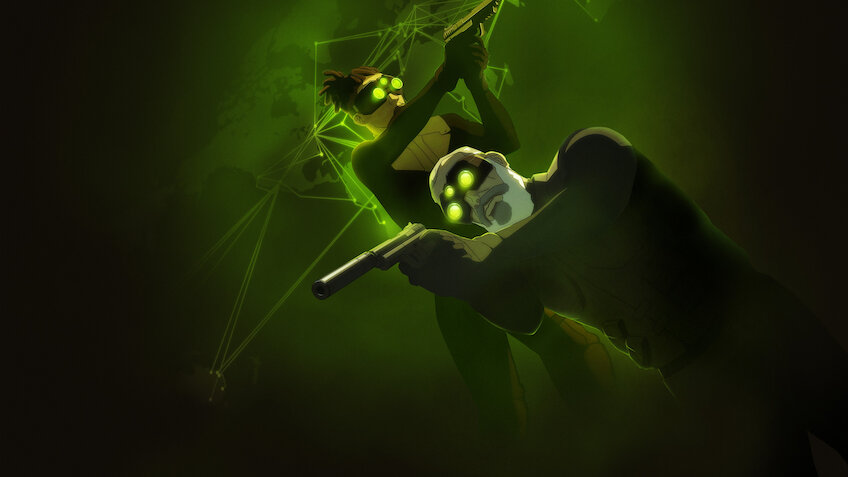

The universe of stealth and covert operations created by Tom Clancy is returning to the forefront of global entertainment with an ambitious new project. Produced by Ubisoft Film & Television, a new adult animated series is set to infiltrate Netflix, promising to expand one of the most influential video game franchises of the last two decades.
Officially titled Tom Clancy’s Splinter Cell: Deathwatch, this adaptation aims to forge a new chapter for its iconic protagonist, taking him into territory that is more unexplored and personal than ever before.
The Return of a Legend: Sam Fisher is Back in Action
The core of the Splinter Cell saga has always been its protagonist, Sam Fisher. The new series delves into the character’s psyche, presenting him at a radically different stage of his life than fans of the franchise are used to.


Splinter Cell: Deathwatch moves away from the image of an agent at the peak of his career to explore the figure of an “Old Man Sam.” The narrative finds an older Fisher, retired from active service and living a solitary, secluded existence in rural Poland. However, the past rarely stays buried, and circumstances force him out of his self-imposed retirement, dragging him back into the world of black ops he once dominated.
This premise draws inspiration from classic film archetypes, such as Clint Eastwood’s twilight western Unforgiven and the aged anti-hero of Old Man Logan, presenting a man surprised to have outlived his own life. To bring this new incarnation of the character to life, the production has cast actor Liev Schreiber, whose voice will take on the mantle of Sam Fisher. This casting decision was not merely the choice of a recognizable star but a calculated and thematically resonant move.
This change of voice represents a significant transition for the franchise. For years, the character of Sam Fisher was synonymous with the deep, authoritative voice of Michael Ironside, who portrayed him in most of the video games. Aware of the importance of this legacy, the producers approached the change with notable deference.
The Supporting Cast
Sam Fisher won’t be operating alone on this new mission. He is joined by a cast of characters who promise to be central to the plot.
Actress Kirby Howell-Baptiste has been confirmed to play Zinnia Mckenna, described as a young agent who seeks Fisher’s help after being wounded in an operation. Her presence appears to be the catalyst that pulls Fisher out of retirement, establishing a mentor-protégé dynamic at the heart of the story. The voice cast is rounded out by Janet Varney as technical officer Anna Grimsdottir and Joel Oulette as a new character named Thunder.
“Deathwatch”: A New Mission in the Splinter Cell Canon
The series is not a reboot or a standalone story but an addition to the timeline established by the video games, exploring the long-term consequences of Fisher’s life.
The official plot of Splinter Cell: Deathwatch kicks off when the young agent Zinnia Mckenna, gravely injured, tracks down Sam Fisher in his hideout. By helping her, Fisher inevitably becomes entangled in the mission that left her incapacitated, uncovering the threads of a vast global conspiracy that he must unravel. The narrative takes on a deeper nuance by revealing that this mission is intensely “personal” for Fisher, suggesting that the antagonists and objectives are directly connected to his own operational past.
The plot centers on a covert biological weapon and unfolds against the backdrop of the fictional COP 31 climate conference, exploring contemporary themes like hybrid warfare and the weaponization of disinformation to destabilize nations.
Echoes of “Chaos Theory”: The Legacy of Shetland
For longtime fans of the saga, the most significant connection to the video game lore comes from the reappearance of a key name: Douglas Shetland. The series will revisit events from the acclaimed 2005 video game, Tom Clancy’s Splinter Cell: Chaos Theory, through flashbacks, exploring the complex and tragically fractured friendship between Sam Fisher and his former comrade-in-arms. A preview of the series even shows an image of a coffin bearing Shetland’s name, confirming his death as a central event in the story’s background.
The main present-day plot is directly driven by Shetland’s legacy, embodied by his two children, Diana and Charlie. Both control their father’s former company, the infamous private military corporation Displace International. Diana, the more pragmatic of the two, has tried to clean up the company’s image, rebranding it as a global green energy firm. Meanwhile, her half-brother Charlie craves a more prominent role and seeks to step out of his sister’s shadow. The activities of Displace International under the Shetland siblings’ leadership form the core of the conspiracy that Fisher and Mckenna must confront, forcing the veteran agent to face the ghosts of one of his most difficult missions.
The Architects of Espionage: The Creative Team Behind the Scenes
The caliber of a project of this magnitude can often be measured by the talent assembled behind the production. Splinter Cell: Deathwatch boasts a creative team that combines the sensibilities of modern action cinema with the mastery of European animation.
At the head of the writing team, serving as lead writer and executive producer, is Derek Kolstad. Kolstad is a key figure in contemporary action cinema, recognized worldwide as the creator of the blockbuster John Wick franchise and the screenwriter of the film Nobody. His involvement is a clear indication of the direction the series will take.
Kolstad’s approach to Deathwatch is a direct application of his signature narrative archetype: the legendary and highly competent figure who is pulled out of self-imposed retirement to confront his past. This formula, perfected in John Wick and Nobody, is now being applied to Sam Fisher.
The series is directed by a duo of emerging talents from French animation: Guillaume Dousse as director and Félicien Colmet-Daage as co-director. Dousse is known for his work on the acclaimed Netflix anthology Love, Death + Robots, where he directed the short “Alternate Histories.” Colmet-Daage boasts an impressive credit as the animation director for the award-winning film The Summit of the Gods, a work praised for its stunning visual storytelling and thematic maturity. This combination of an American screenwriter known for kinetic action and European directors celebrated for their visual sophistication suggests a deliberate fusion of styles.
As expected, Ubisoft, the company that created the franchise, is deeply involved through its Ubisoft Film & Television division. The series’ executive producers include key figures from this division, including Helene Juguet, Hugo Revon, and Gerard Guillemot.
A World of Angles and Shadows: The Series’ Visual Aesthetic
The animation for the series is a co-production between two high-profile European studios: the Danish-French studio Sun Creature and the French studio Fost. Their portfolios include work on critically acclaimed and internationally award-nominated films such as Flee, Wolfwalkers, and the aforementioned The Summit of the Gods.
The series is made in 2D animation, with a distinctive visual style described as “sleek and sparse,” characterized by a restrained color palette and an atmosphere of “penumbra.” This aesthetic approach is functional, drawing from an eclectic mix of influences ranging from the films of Michael Mann to the work of anime director Satoshi Kon and the cyberpunk classic Ghost in the Shell.
The character designs follow this same philosophy, with “angular” features and faces that often display a deliberate lack of expression. This stylistic choice reinforces the “steely demeanor” that defines nearly all the characters, a visual reflection of their training, discipline, and the emotionally repressed world in which they operate.
The Legacy of Third Echelon: Over Two Decades of Stealth
The Tom Clancy’s Splinter Cell saga burst onto the video game scene in 2002. The game redefined the stealth-action genre, introducing innovative gameplay mechanics that placed an unprecedented emphasis on light and darkness. The series distinguished itself with its realistic approach to espionage, equipping its protagonist with an arsenal of high-tech gadgets and basing its missions in a world of believable geopolitical tensions. The most enduring symbol of the franchise became Sam Fisher’s iconic night and thermal vision goggles, with their three glowing green lenses.
Throughout six main games and several novels, players have followed the career of Sam Fisher, a Navy SEAL veteran recruited by the National Security Agency (NSA) to be the first field agent of a new covert operations division called “Third Echelon.” Later in the saga, after Third Echelon was dissolved, Fisher was placed in command of a new elite unit, “Fourth Echelon,” which answered directly to the President of the United States. This extensive history serves as the canonical starting point for the new animated series.
The global premiere of Tom Clancy’s Splinter Cell: Deathwatch is scheduled for October 14.