


The year 1997 is etched into South Korea’s collective memory as a devastating turning point, a moment when the prosperity of a booming nation came to a sudden halt. The Asian financial crisis, known locally as the “IMF Crisis,” swept over the country like a natural disaster, causing the collapse of countless companies, skyrocketing unemployment, and forcing the government to request a bailout from the International Monetary Fund. It was a national trauma that dismantled certainties and compelled a generation to reevaluate their priorities and their very capacity for survival.
It is against this turbulent historical backdrop that the new South Korean series, Typhoon Family, is anchored. The production captures the “spirit of a generation navigating the storms” of this crisis, exploring the struggles and transformations of a youth thrust into maturity by the force of circumstance. The central premise focuses on the odyssey of a young, inexperienced CEO and his small team as they fight desperately to protect a small family business from the whirlwind of bankruptcy that is dragging down corporate giants. The series presents itself not as a lament for what was lost, but as a story about “ordinary people” who found strength in community and carried on when “all seemed lost.”
The series is directed by the duo Lee Na-jeong and Kim Dong-hwi, correcting initial reports that pointed to another filmmaker. This creative team has set out to revisit one of the country’s darkest economic moments, not to dwell on the drama, but to extract a message of hope. In a contemporary global context marked by its own uncertainties—economic crises, pandemics, and geopolitical conflicts—the story of Korea in 1997 serves as a powerful mirror. The production team and cast have repeatedly expressed their wish for the series to offer “comfort and courage to those facing difficult times today” and to serve as a “message of support to all who live fiercely in the present, regardless of the era or generation.” In this way, Typhoon Family uses a specific national trauma to explore universal themes of resilience, solidarity, and optimism, building a narrative bridge between a past crisis and the global anxieties of today.


The Fall of the Prince of Apgujeong: The Journey of Kang Tae-poong
To understand the magnitude of protagonist Kang Tae-poong’s transformation, one must first understand the cultural phenomenon he was part of: the “Orange Tribe.” This term, often used with a sarcastic edge, emerged in the early 1990s to describe the wealthy young people of Seoul’s Gangnam district, particularly from the Apgujeong area. They were the heirs of South Korea’s new wealth, known for their lavish lifestyles, fondness for imported cars and luxury goods, and a carefree attitude funded by their parents’ generosity. The name “Orange” referred to imported oranges, a symbol of foreign luxury at the time, and evoked an image of youth who had studied abroad, were deeply influenced by Western culture, and lived in a consumer bubble that starkly contrasted with the work ethic of previous generations.
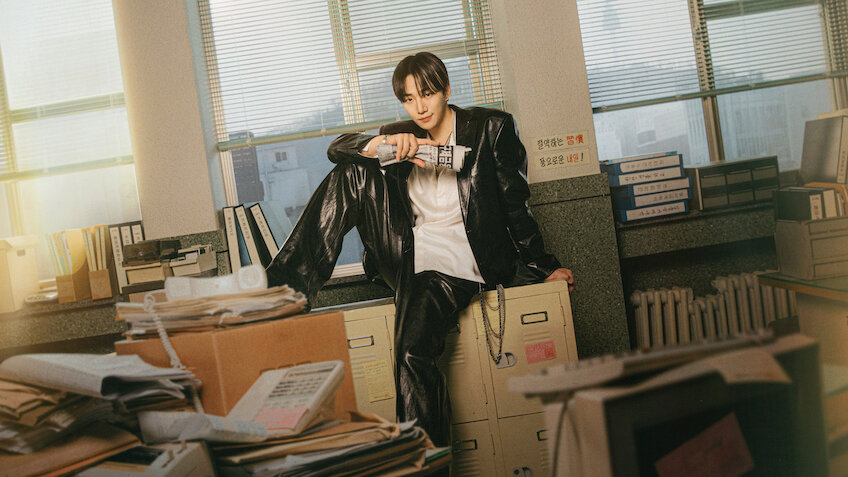
Kang Tae-poong, played by actor and singer Lee Jun-ho, is the perfect embodiment of this subculture. Before the crisis, he is a “carefree playboy,” a “rich and extravagant young man,” and a “free spirit” whose only concerns are fashion and fun. His world, built on the foundation of his family’s fortune, crumbles with the arrival of the IMF crisis and the sudden death of his father. Overnight, he is catapulted into the presidency of the family business, Typhoon Company, an entity on the verge of collapse with “no employees, no money, and nothing to sell.”
This brutal change in circumstances kicks off a transformative arc that is the heart of the series: the journey from “wild young man to rookie boss.” Tae-poong is forced to abandon his privileged lifestyle to confront the “harsh realities of survival.” However, the narrative reveals that beneath his immature facade, the character possesses latent qualities: a “warm heart, a strong sense of responsibility, and a spirit of perseverance.” Lee Jun-ho himself has described Tae-poong as a character with a wide range of emotions, fundamentally honest and lovable, endowed with an “unbreakable spirit” that “never loses hope.” The actor confessed to feeling a special connection with the character, as he founded his own entertainment agency shortly before filming began, allowing him to empathize deeply with Tae-poong’s challenges.
Kang Tae-poong’s journey can be seen as a microcosm of South Korea’s own forced maturation during the crisis. The “Orange Tribe” represented, in a way, the exuberance and excess of the 1990s “bubble” economy, a phase viewed with suspicion by those who had built the country from austerity. The IMF crisis was a violent reality check for the entire nation, which had to return to fundamental values like collective effort and solidarity. Tae-poong’s trajectory directly reflects this process: he is stripped of his superficial wealth and forced to discover his inner substance. His evolution from consumer to protector is not just a personal story of growth, but a redemptive allegory for a generation, suggesting that even the most seemingly frivolous members of a society possess a deep capacity for resilience when put to the test.
The Determination of Oh Mi-seon
As a crucial counterpoint to Kang Tae-poong’s impulsiveness stands Oh Mi-seon, played by actress Kim Min-ha. If Tae-poong represents the carefree elite who must learn to survive, Mi-seon embodies the hardworking and resilient core of South Korean society. She is described as a “tenacious and determined accountant,” the “quintessential responsible eldest daughter” who works 11-hour days to support her family. Her character symbolizes the ambition and perseverance of women seeking to build a career in a “male-dominated world” at that time.
In the narrative of Typhoon Family, Mi-seon is much more than a romantic interest or a supporting character; she is the “anchor in the storm” and the “brains” of the company’s rescue operation. While Tae-poong, the “action hero” of the story, relies on his “instinct” and acts impulsively, Mi-seon brings logic, meticulousness, and deep practical knowledge. Her calm demeanor, quiet strength, and diligence provide the stability that both the company and its new, inexperienced boss desperately need. In turn, she finds hope in Tae-poong’s unwavering determination, creating a symbiotic relationship where they strengthen each other.
Actress Kim Min-ha has expressed feeling “honored” to play such a strong character and hopes that viewers will “feel every moment: the youth, the hope, the hardship, and the triumph.” To prepare for her role, Min-ha immersed herself in the history of the era, even interviewing her own parents about their experiences during the IMF crisis, a detail that underscores her commitment to the character’s authenticity.
The dynamic between Kang Tae-poong and Oh Mi-seon transcends the romantic-comedy archetype to become a powerful metaphor for national recovery. The actors themselves describe their characters as “complete opposites in every way.” He is the privileged heir guided by intuition; she is the working-class daughter guided by logic. The economic crisis erases the social barriers that, in other circumstances, would have kept them apart. His privilege becomes useless, while her practical skills become invaluable. Their collaboration, therefore, symbolizes the necessary union of different social strata and philosophies for Korea’s survival. The series argues that the national recovery was not the work of a single class but the result of a forced, yet ultimately fruitful, synthesis. The synergy between them, as Kim Min-ha describes, “not only saves the company, but their unbreakable determination helps them finally get back on their feet,” a direct echo of the national narrative of overcoming adversity through collective action.
A Family Forged in Crisis
Beyond its two protagonists, Typhoon Family places a crucial emphasis on the ensemble of employees fighting to keep the company afloat. The production team refers to them as the “‘Typhoon Special Force'” and highlights their “‘one-team’ spirit” as a fundamental pillar of the narrative. This diverse group of individuals becomes a “found family,” forged in the crucible of adversity, proving that the bonds created in struggle can be as strong as those of blood. The importance of this supporting cast is a recurring theme in the production team’s statements. They affirm that the chemistry among the members of Typhoon Company “has a meaning that goes beyond being mere colleagues” and that, through the process of “covering for each other’s shortcomings and sharing laughs in difficult times, they will provide a vibrant energy to today’s viewers.” This approach reinforces the series’ central message: survival is a collective, not an individual, effort.
The IMF crisis is often associated with the spectacular collapses and restructuring of the chaebols, the giant Korean conglomerates like Daewoo. Many cultural productions have focused on the power struggles within these monolithic entities. Typhoon Family, in contrast, offers a counter-narrative. By highlighting a small company whose spirit is based on loyalty, mutual support, and camaraderie, the series champions a more humane and communal model of capitalism. It moves away from ruthless corporate Darwinism to suggest that the true strength of the Korean economy and society lies not in its impersonal giants, but in the resilience, solidarity, and human warmth of its smaller businesses. It is a powerful reminder that in times of crisis, community can be the most valuable asset.
Recreating an Era
The world-building of Typhoon Family is the result of a meticulous creative vision that seeks to balance historical authenticity with a specific emotional tone. Screenwriter Jang Hyun-sook found initial inspiration in the humorous anecdotes her superiors told her about their days as salespeople in an era before mobile phones. This anecdotal and human origin set the tone for the entire series. The writer’s primary goal was not to document despair but to convey “warmth” and the Korean concept of jeong, a term describing a deep and affectionate connection between people. Jang Hyun-sook has explicitly stated that Typhoon Family is a story about “hope and love,” not “despair or sadness.”
This vision was shared and executed by director Lee Na-jeong, whose approach focused on rigorous authenticity without sacrificing the optimistic tone. The directing team conducted extensive research, interviewing former office workers and trading company employees from the era to capture the essence of their experience. They discovered that, despite the harshness of those years, people remembered how they “overcame difficulties together and never lost their spirit.” To bring this authenticity to life, the production went so far as to source props from the era at museums and faithfully recreate workspaces, but always with the goal of infusing them with a “warm and friendly feeling.”
The attention to detail is evident in the production design. The fashion of the ’90s was meticulously recreated, from leather jackets and the “denim on denim” trend to characteristic hairstyles like the “bridge haircut” worn by the protagonist. The commitment was such that actor Lee Jun-ho personally invested his own funds to acquire costumes he felt were authentic for his character. The reconstruction of iconic locations like Rodeo Drive in Apgujeong and the use of realistic sets allowed the actors to fully immerse themselves in the atmosphere of 1997, making the scenes feel almost like archival footage.
This creative approach represents a significant evolution in how South Korean culture processes its national traumas. While early artistic responses to a crisis often focus on pain and blame—like the political thriller tone of the film Default (2018), which also addresses the IMF crisis—Typhoon Family consciously chooses a different path. By framing a story of economic hardship through warmth, humor, and hope, the series moves from simply processing the event to canonizing the human response to it. The focus is not on the mechanics of the crisis, but on the indomitable spirit of those who lived through it. In this way, the series transforms a memory of hardship and national shame into a foundational myth about the Korean character: resilient, communal, and eternally hopeful. It is a form of cultural healing that reframes a painful past as a source of collective pride and strength.
A Message of Encouragement for Uncertain Times
At its core, Typhoon Family transcends the label of a period drama to become a contemporary fable with a clear and direct message for today’s audience. The series deliberately builds a bridge between the “uncertain tomorrow” of 1997 and the challenges facing global society in the present. It is a story that, according to its cast and creators, aims to resonate universally.
This purpose is most eloquently articulated through the words of its protagonists, who have taken on the role of ambassadors for the series’ message of encouragement. Lee Jun-ho has expressed his wish to “send words of encouragement to all who are living a fierce present… I hope this drama becomes a small comfort and source of strength.” His message underscores the series’ intention to offer an emotional refuge, a reminder that perseverance is possible. Kim Min-ha complements this idea with a deeply personal and touching note of hope: “When you truly feel you’re in the dark and feel like you’re not moving forward, if you look around, there is always at least one dim light… you are not alone.” These statements are not mere promotions; they encapsulate the series’ thematic core: faith in the light that persists even in the darkest moments.
The ultimate theme of Typhoon Family is, therefore, the enduring power of human connection and resilience. It is a story about “getting back up with the ones you love, finding strength in unexpected places.” The narrative proposes that solidarity—whether familial, communal, or professional—is the most effective tool for overcoming any crisis.
The series premieres globally on Netflix on October 11, 2025.