


It’s no secret that Turkish productions are a global phenomenon, and Netflix knows it. The platform also understands that stories of romance, power, and money have an undeniable pull for audiences. Enter a new series destined to redefine expectations: “Old Money.”
Known in its original language as “Eski Para,” this dramatic series is poised to be one of the most significant Turkish releases of the year. This high-caliber production is set to arrive on international screens via Netflix, promising to immerse viewers in the heart of Istanbul’s elite—a world where ancestral traditions and new fortunes wage a silent but relentless battle for dominance.
The core theme of “Old Money” lies in a conflict as old as wealth itself: the collision between “old money” and “new money.” This isn’t just a dispute over financial assets or social influence; it’s a fundamental clash between two philosophies, two ways of understanding power, and two diametrically opposed codes of conduct. On one side is the world of generational wealth, a universe governed by diplomacy, strategic alliances forged over decades, and a deep sense of legacy. On the other, the disruptive force of self-made capital bursts onto the scene—a raw, audacious energy that refuses to play by the old rules and is ready to change the game to win.


The narrative delves into this struggle, exploring how the arrival of a self-made tycoon threatens to destabilize the delicate balance of power that has governed Istanbul’s high society for generations. The plot is designed to explore the complexities of personal ambition, internal power struggles, and the profound romantic conflicts that arise when these two worlds collide. The series presents itself as a reflection on power dynamics in contemporary society and the social changes that shape human interaction. In a country characterized by rapid growth and the constant emergence of new power centers, the story of a “new money” magnate challenging an established dynasty resonates with particular relevance, potentially mirroring the aspirations and anxieties of our time.
The Plot: A Battle of Wits, Will, and Heart
The central premise of “Old Money” is encapsulated in a stark golden rule: “Whoever changes the game, wins.” This maxim establishes from the outset that the story will unfold not on a conventional battlefield, but on a psychological chessboard where strategy, manipulation, and the ability to subvert expectations are the primary weapons. The conflict will not be resolved through brute force, but through a war of intellect and will—a contest explicitly described as a “battle of wits and diplomacy” and a “clash of power and intellect.” Every move, every word, and every decision will be loaded with strategic intent, turning personal interactions into tactical maneuvers.
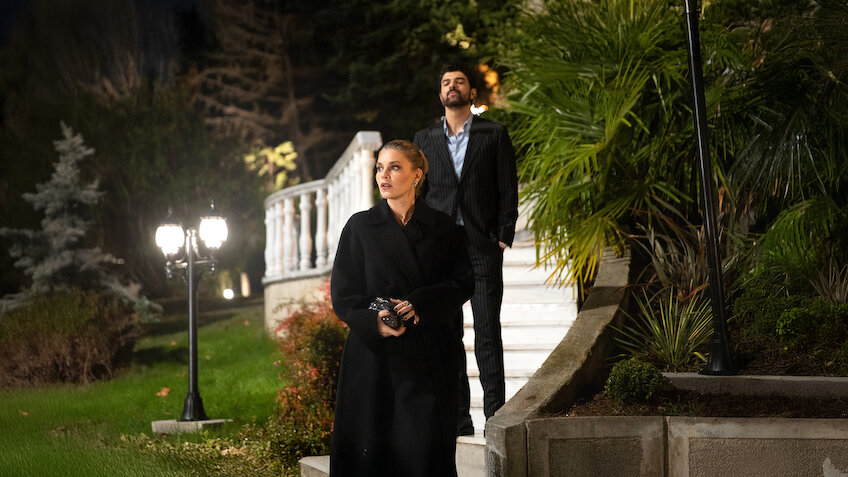
The plot’s dynamic is built on the opposing methods of its two protagonists. On one hand is the strategy of Osman, the tycoon who fought his way up from nothing. His approach is based on “bold and decisive moves,” an aggressive and direct tactic that has allowed him to amass immense fortune and considerable power. His method is one of disruption, of rewriting the rules in his favor.
On the opposite side is Nihal, the heiress of an established dynasty, whose power lies in her mastery of “diplomacy.” Her approach is subtle, calculated, and strategic, relying on influence, alliances, and a deep understanding of the unwritten rules that govern her world. This fundamental contrast between overwhelming force and strategic finesse is the main engine of the narrative conflict.
However, in the midst of this calculated war for power, an unpredictable and potentially catastrophic variable emerges for both sides: love. The series introduces romance not as a mere subplot, but as the catalyst that threatens to derail the most carefully laid plans. The fundamental question posed by the synopsis is whether either contender can truly claim victory once they begin to develop feelings for each other.
Dialogue from the official trailer suggests this relationship will be far from a conventional idyll, delving into a territory of psychological warfare. Lines like, “Don’t you feel bad treating her like this, like a cat playing with a poor little mouse?” and “Call it what it is, it’s love,” reveal a complex mix of manipulation, desire, and vulnerability. The love affair thus becomes the main arena where their battle is waged—a dangerous game that constantly questions the authenticity of feelings and the true nature of intentions, leading the characters to ask: “What if we are both about to lose?”
The Adversaries: Protagonist Profiles
The driving force of “Old Money” lies in its two complex central characters, figures who not only represent opposing factions in a power struggle but also embody fundamentally different worldviews.
Osman: The Magnate Forged in Adversity
Osman is the personification of “new money,” a man whose story is a testament to relentless ambition. He is defined as having “started from nothing” to become an immensely wealthy and powerful tycoon. His rise was not a product of luck, but the result of “bold and decisive moves”—a series of masterstrokes that allowed him to build an empire from scratch. He is a “self-made man” in the truest sense, one who did not inherit his power but seized it.
His psychological makeup is that of a strategic predator. Descriptions from the trailer paint him as “the brains of the family. A real shark,” a metaphor that underscores his calculated and lethal nature in the business world. He is said to be cold, with “ice in his veins,” suggesting ironclad emotional control and a willingness to make ruthless decisions to achieve his goals. This complex and multidimensional character is portrayed by the acclaimed actor Engin Akyürek, known for his ability to bring characters of great psychological depth to life in productions like Fatmagül and Black Money Love.
Nihal: The Diplomatic Heiress of a Legacy
In the opposite corner is Nihal, the embodiment of “old money.” She is the “heiress of a well-established shipping family,” a dynasty whose name and fortune have been synonymous with power for generations. Her life, until now secure and opulent, is directly threatened by Osman’s arrival in her world, a man whose ambition challenges everything she represents.
Nihal’s strength, however, lies not in aggression or ostentation, but in her intellect and refined strategic skill. She is repeatedly described as a “master of diplomacy” and an “old-school diplomat.” This positions her not as a passive victim of circumstances, but as a formidable adversary—a player whose power is manifested in her ability to negotiate, influence, and maneuver within the complex structures of high society. Her character defies traditional archetypes, presenting herself as a force equal to Osman’s, though different in nature. The role is played by the renowned actress Aslı Enver, celebrated for her work in series like The Bride of Istanbul.
The dynamic between these two archetypes suggests a nuanced exploration of power and gender. While Osman represents a traditionally masculine form of power based on conquest and aggression, Nihal’s power is intellectual and strategic. The conflict is framed as a struggle between “power and intellect,” implying a confrontation between two equally valid forms of strength. This narrative setup avoids gender clichés and presents the female protagonist as a full-fledged strategist, with an agency and will that make her an active participant in the dangerous game unfolding. The trailer’s dialogue, “Things only happen when you want them to happen, but you want this too,” seems directed at her, underscoring her conscious involvement and desire to engage in the confrontation, rather than being a mere pawn on Osman’s board.
A Prestigious Cast Leading the Production
One of the pillars supporting the high expectations for “Old Money” is undoubtedly its exceptional cast. The series is led by two of the most respected and talented figures in the Turkish television industry: Engin Akyürek and Aslı Enver. Both have remarkable careers and a great interpretive ability that has earned them recognition from both local and international audiences.
Engin Akyürek is a familiar face to global audiences thanks to his roles in television phenomena such as Fatmagül, the first Turkish series to premiere in Spain, and Black Money Love, as well as more recent productions like My Name is Farah. For her part, Aslı Enver has captivated viewers with her charisma and talent in highly successful series like The Bride of Istanbul. The on-screen reunion of Akyürek and Enver has generated considerable excitement among fans of Turkish fiction, who have expressed their eagerness on social media to witness their chemistry in this new collaboration. This star power not only guarantees top-tier performances but also serves as a key strategic asset, positioning “Old Money” as one of the most anticipated Turkish productions of the year.
Beyond its leading duo, the series features a solid and extensive supporting cast that reinforces its status as a prestige production. The cast is rounded out by a group of highly talented and recognized actors, including Dolunay Soysert, İsmail Demirci, Serkan Altunorak, Taro Emir Tekin, Selin Şekerci, Sedef Avcı, Zeynep Oymak, Armağan Oğuz, and Ahmet Utlu. The presence of such a robust and diverse ensemble is a clear indicator of the project’s ambition and the investment made to ensure the highest quality in all aspects of production.
The Creative Team
The series is backed by some of the most influential figures in the Turkish creative industry, ensuring flawless execution on both a narrative and visual level. The production is handled by TIMS & B Productions, a company with vast and recognized experience in creating “exceptional content” that has left an indelible mark on Turkish and international television. At the helm are executive producers Timur Savcı and Burak Sağyaşar, two names synonymous with quality and success in the sector.
The show’s narrative architecture has been entrusted to screenwriter Meriç Acemi, a writer known for her ability to build intelligent plots and complex characters that resonate with audiences. The direction is in the hands of Uluç Bayraktar, a filmmaker whose work is characterized by a distinctive visual style and careful direction of actors. The combination of this creative talent promises to deliver an immersive and sophisticated experience, capable of keeping viewers hooked from the very first episode.
The making of “Old Money,” which was originally set to be titled ‘Kusatma’ (‘Blessing’), is a clear example of Netflix’s global strategy of investing in top-tier local talent to develop productions with universal appeal. The platform acts not as a mere distributor, but as an active partner in the creative process. By commissioning a project of this magnitude to an elite production company like TIMS & B, with a renowned creative team and starring two of the country’s most important actors, Netflix is executing a well-defined plan. This strategy seeks to leverage strong local creative ecosystems to generate content that is authentically Turkish in its essence, yet possesses the high production values and compelling narrative structure necessary to compete in the global market. The series is a tangible manifestation of Netflix’s “commitment to Turkey’s creative industry,” an effort to bring exciting stories from the Turkish market to the rest of the world. Therefore, “Old Money” is not just a Turkish series available on Netflix; it is a strategic co-production designed to become a flagship of Turkish drama worldwide.
Global Premiere on Netflix
“Old Money” (“Eski Para”) stands as one of Turkish fiction’s strongest bets for the season, a story that intertwines dramatic tension with a profound reflection on the nature of human power. The series will be distributed as a Netflix Original production, ensuring its availability to a global audience exclusively on the streaming platform.
The series will be available worldwide on Netflix starting October 10.