
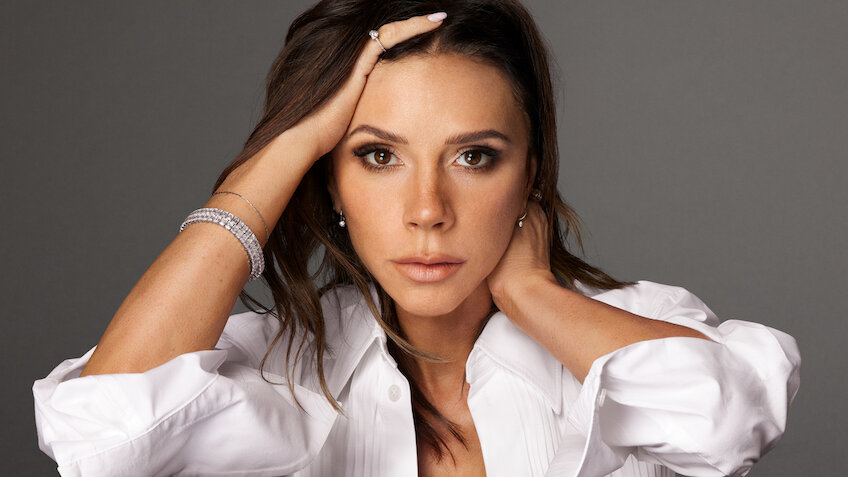

Netflix is set to release Victoria Beckham, a three-part docuseries promising to unveil the untold story of the former Spice Girl, renowned fashion icon, and wife of David Beckham. In the style Netflix is known for, the documentary aims to present an intimate and sincere look into the star’s life, with Victoria Beckham herself telling her story firsthand.
Structured in three episodes of approximately 50 minutes each, the production chronicles her journey beyond superficial fame, diving deep into the relentless ambition and struggle for professional legitimacy that have defined the second half of her career. The platform’s official synopsis traces an expansive narrative arc, beginning with her “formative years and her rise to unprecedented success with the Spice Girls,” moving through her “high-profile relationship with football legend David Beckham,” and culminating in her “incessant work to establish herself in the ruthless world of high fashion.”
The project is explicitly presented as an attempt to “set the record straight,” offering an “intimate” and “unfiltered” look at a life lived under constant media scrutiny.


A key detail about the project’s origin reveals its strategic nature: it was her husband, David Beckham, who persuaded her to do it. Following the success of his own docuseries, David felt his wife’s work ethic remained invisible to the general public. His goal was for people to see “what she does every day and what her business entails,” arguing that “no one gets to see” her dedication. This genesis underscores that the series is not a spontaneous act but a calculated move to complete the narrative of “Brand Beckham.” It serves as a companion piece to the acclaimed 2023 series Beckham, which not only earned Emmy nominations but also generated renewed interest in Victoria, especially after the viral moment where she discussed her “working-class” origins. The production, handled by Studio 99, a company co-founded by David Beckham himself, ensures total narrative control, positioning the docuseries as the second half of a media diptych designed to cement the couple’s legacy for a new generation.
Vulnerability, Pressure, and the Search for Acceptance
The emotional core of the docuseries lies in its promise to dismantle the stoic facade that has characterized Victoria Beckham’s public image for years. The production directly addresses her reputation, with her acknowledging, “People thought I was that miserable cow who never smiled.” She explains that her famous “poker face” was, in part, a “defense mechanism” against overwhelming media attention.
The narrative goes back to her formative years to contextualize her insecurities. She describes herself as an “odd, unpopular kid at school,” a confession accompanied by childhood photos as she recounts her yearning for validation: “But I desperately wanted to be liked, to have a sense of worth.” This feeling of being an “outsider” becomes a common thread throughout her career, from her early days to her venture into fashion.
The series also explores the abrupt end of her music career, a moment of profound uncertainty. “Performing was my dream. The Spice Girls made me accept who I am. And then, suddenly, it all stopped,” she states in a preview. Beckham herself has admitted that revisiting this period and answering questions about the Spice Girls for the documentary was “quite triggering,” suggesting wounds that still linger.
In this story, fashion emerges not just as a second career but as a vehicle for self-expression and survival. “Fashion was this creative outlet,” she explains, a way to channel her identity beyond music. She details how she used clothing as a tool for personal transformation: “Throughout my life, I’ve used clothes to become someone else, to be the person I always wanted to be, who maybe I wasn’t naturally.”
Ultimately, the docuseries reveals that the driving force behind her relentless ambition is deeply connected to her family. In a highly emotional moment, she confesses through tears, “I want my kids and David to be proud of me.”
This display of vulnerability appears to be a deliberate strategy. The choice of director Nadia Hallgren, whose work on Becoming about Michelle Obama was praised for its ability to empathetically capture authenticity, is no coincidence. Victoria herself admits that only now does she feel “secure” enough in her brand to “talk about the past” and the “struggles,” knowing that “it’s not going to damage the brand.” By revealing her insecurities from a current position of strength, the narrative seeks to transform the perception of her ambition from cold and distant to tenacious and resilient.
Chronicle of an Entrepreneurial Struggle
The central focus of the docuseries is the chronicle of Victoria Beckham’s arduous battle for acceptance in the fashion industry. The series frankly documents the skepticism she faced when transitioning from a pop star to a designer. Her friend, actress Eva Longoria, recalls in the series the warnings she received: “Everyone was warning her, ‘You won’t be accepted.'” Victoria herself remembers the general perception at the time: “People thought, ‘She was a pop star. She’s married to a footballer. Who does she think she is?'”
However, the reality of her 2008 debut was surprisingly different. Despite widespread industry skepticism, the reaction from editors and buyers who attended her intimate presentation at the Waldorf hotel in New York was overwhelmingly positive. Her first collection, a curated selection of ten dresses, was described as “beautiful,” “desirable,” and “classy.” The Times described it as a “very impressive and accomplished collection, without a single flaw.” Beckham avoided the spectacle of a large runway show, opting to personally present each look, explaining the fabrics and techniques—a humble and personal strategy that won over an audience preparing for disdain. The quality was so high that some wondered if she had hired a ghost designer, a rumor she has always denied and which underscores the success of her first foray.
This initial critical validation, however, did not translate into immediate financial success. The real battle was not for critical acclaim but for business survival. The production delves for the first time into the severe financial difficulties that nearly destroyed her company, a fifteen-year journey to profitability. It is revealed that the brand was “millions in the red,” a situation that created immense “panic.” Her husband David also confesses in the series that the financial pressures left him “in a panic.”
“I haven’t spoken before about the difficulties the business has gone through,” Victoria states, highlighting the novelty of these revelations. “It hasn’t all been easy.” Launched in 2008, the namesake brand endured over a decade of significant losses. Financial reports external to the production indicate that the company accumulated debts reaching £53.9 million by 2022, a figure that illustrates the magnitude of the risk taken. By quantifying her struggle in such stark financial terms, the docuseries aims to reframe her story, moving it away from the “vanity project” narrative that often plagues celebrity brands. Instead, it presents a risky entrepreneurial venture, aligning her with the archetype of the startup founder who risks everything for a vision.
The fact that the brand has recently achieved a turnaround, driven largely by the success of its beauty line launched in 2019 and best-selling leather goods, allows this story to be told in retrospect. It is not a confession of current failure but the chronicle of a heroic journey of survival and perseverance, culminating in the definitive validation of Victoria Beckham as a serious entrepreneur legitimized by the industry that once rejected her.
An Intimate Look at the Creative and Family Process
The docuseries offers unprecedented access to the inner workings of both the fashion brand and the Beckham family dynamics. A significant part of the narrative follows Victoria as she prepares “for the biggest fashion show I’ve ever done,” a high-stakes event at Paris Fashion Week that serves as the backbone of the plot. This provides a detailed look at her creative process and the pressures of operating at the highest level of the industry.
The story is enriched with interviews and conversations with her inner circle. Key figures like actress Eva Longoria and iconic designer Tom Ford offer their perspectives, acting as credible witnesses who validate both her personal character and her professional talent. Ford’s participation, in particular, serves as a stamp of approval from the fashion elite, a recognition Beckham has long sought.
Family dynamics also take center stage. David Beckham appears throughout the series, and the participation of their four children is confirmed. A preview clip shows their eldest son, Brooklyn, helping to clear rainwater from the runway at the crucial Paris show, a scene that seems designed to counteract tabloid narratives about supposed family tensions. This exclusive access extends to the Beckham home, with never-before-seen archive footage promising a glimpse into their private life that complements the professional focus. This inclusion of the family serves a dual purpose: on one hand, it humanizes Victoria, showing her in her roles as a mother and wife. On the other, it reinforces the image of a solid family unit that has been fundamental to her success. The support system, which includes influential friends and a close-knit family, collectively builds a holistic and positive portrait that reinforces the series’ central message.
The Team Behind the Camera: A Stamp of Prestige
To contextualize the project’s ambition and caliber, it is essential to look at the creative team that made it possible. The docuseries is directed by Nadia Hallgren, a highly respected filmmaker in the documentary world. Hallgren is the acclaimed director of Becoming, the four-time Emmy-nominated Netflix documentary that offered an intimate portrait of former First Lady of the United States, Michelle Obama. Her style is characterized by cinematography that captures the authenticity and vulnerability of her subjects, creating empathetic and uplifting narratives that allow the audience to connect with them.
The production is handled by the same team responsible for the success of Beckham, the 2023 series that won an Emmy and became a global phenomenon. This direct connection establishes a standard of quality and suggests a similar narrative approach, focused on introspection and the analysis of a monumental career. The production companies are Studio 99, the media company co-founded by David Beckham, and Dorothy St Pictures. The executive producers include award-winning figures like Nicola Howson, an Emmy nominee for Beckham, and Julia Nottingham, a BAFTA nominee for Pamela, a Love Story, another documentary that sought to allow a highly publicized female figure to reclaim her own story.
The selection of this team is a statement of intent. It indicates a deliberate effort to create a prestige documentary, far from the reality show format and closer to an authorized cinematic portrait. The choice of Hallgren, in particular, suggests a more empathetic and intimate tone compared to the sometimes more inquisitive style of Fisher Stevens, the director of Beckham, who did not hesitate to press his subjects and even got annoyed when David interrupted an interview with Victoria to correct her. Everything suggests that while the series will address struggles and controversies, the overall framework will be one of triumph and vindication, carefully crafted to solidify Victoria Beckham’s legacy.
Launch
The docuseries is presented as a complete and multifaceted portrait that seeks to reconcile the various identities of its protagonist: the insecure girl who dreamed of the stage, the pop star who conquered the world, the entrepreneur who risked a fortune for a vision, and the matriarch of one of the most famous families on the planet. The docuseries is not just a retrospective of her past but a deliberate act of legacy-building, an attempt to define her own story for posterity, on her own terms.
The three-part docuseries, Victoria Beckham, premieres on Netflix on October 9.