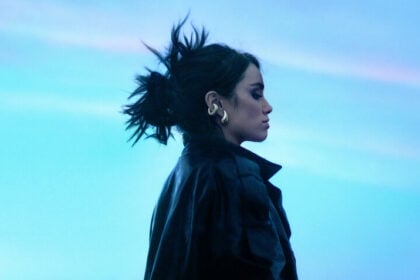



It has happened before with Aitana, Karol G, and even Robin Williams, just to name a few famous singers. And as we’ve seen, when Netflix is involved, even figures like Michael Jordan or Messi grant interviews. This time, it’s the Argentine artist DUKI’s turn. His profile will surely be enhanced, and he will become even more famous thanks to the streaming giant that almost no one can resist (we’ll see what happens with Christopher Nolan).
Filmed in Argentina, Rockstar: DUKI from the End of the World focuses on the life and career of Mauro Ezequiel Lombardo, known artistically as Duki, one of the most representative musicians of his generation. As is customary in these Netflix documentaries, the film will feature the full collaboration of the artist, revealing his most intimate side—a true gift for fans.
The documentary captures its protagonist at a “pivotal moment in his career and artistic identity.” The narrative is anchored in the present, showing a Mauro Lombardo in the midst of transformation, confronting his “internal demons” to move forward with the DUKI project and the movement he represents. This contemporary tension provides a narrative engine that drives the exploration of his past and future. The artist himself has noted the importance of this project in his career.


From Mauro to DUKI: The Duality of an Icon
The narrative and psychological core of Rockstar: DUKI from the End of the World lies in the exploration of a fundamental duality: the tension between Mauro Lombardo, the individual, and DUKI, the superstar. The documentary is structured around a central question explicitly posed by its own synopsis: “Ultimately, who is Mauro and who is DUKI?” This question transforms the film into an investigation of identity, the cost of fame, and the construction of a public persona.
Far from being a simple celebrity profile, the film delves into its subject’s psyche to unravel the conflict that defines his existence. The film promises an “intimate and unfiltered” portrait, showing Mauro “in the midst of shedding his skin” as he confronts his internal struggles and the “demons that accompany him.” The story is supported by unreleased footage, personal archives, and exclusive behind-the-scenes access to explore his childhood, his insecurities, and the challenges he has faced in his meteoric rise.
It reveals that behind the tattooed face and overwhelming stage confidence lies a “sensitive and—as he defines himself—insecure kid.” This vulnerability is key to understanding the character’s complexity. This whirlwind of early fame had chaotic manifestations, such as the era of the mansion on Antezana street, a space of creation and excess from which his own parents had to rescue him, highlighting Mauro’s fragility under the weight of Duki. The image of Duki tattooing an angel and a demon on his face becomes a physical and permanent manifestation of this internal battle, a theme the documentary seems poised to explore in depth.
The Origin: From Rivadavia Park to the World’s Stadiums
The documentary traces a direct line from the movement’s humble origins to its consecration on the world’s biggest stages. The historical narrative is anchored in a foundational place and time: “El Quinto Escalón,” the freestyle competition held in Buenos Aires’ Rivadavia Park. This space is presented not just as a starting point, but as the “cradle of a historic generation of artists” that would define the nation’s urban sound. It was on those five steps of a park staircase that a young Mauro Lombardo began to forge his legend, gaining notoriety for his flow and powerful stage presence, and building his first fan base.
The film documents the crucial moment of his transition from competitor to recording artist. In 2016, after being crowned champion in one of the competition’s events, the prize was a studio session that resulted in his first single, “No Vendo Trap.” The success was immediate and explosive: the video garnered two million views on YouTube in just two weeks, an astonishing figure for an artist without the backing of a record label. However, this first triumph was accompanied by his first clash with the industry, when the video was taken down due to a copyright claim on the beat, showing that Mauro was still a “rapper from the plaza” operating outside formal structures. This early episode underscores a central theme of his career: that of an artist emerging from the grassroots, using digital tools to bypass traditional industry gatekeepers.
From there, the documentary chronicles a meteoric rise. It covers the formation of the influential collective #ModoDiablo, his consolidation with key albums like Súper Sangre Joven and Desde el fin del mundo, and his collaborations with international figures of the stature of Bad Bunny, which cemented his global status. The culmination of this journey is represented by his massive stadium concerts, milestones that mark not only his personal success but that of the entire movement. Selling out four Vélez stadiums, and later the iconic River Plate stadium in Buenos Aires and the Santiago Bernabéu in Madrid, are the visual symbols of his career’s peak, the ultimate proof of how far the “regular kid” who started improvising in a park has come.
Duki’s trajectory, as the documentary will present it, is also an implicit chronicle of the democratization of music production and distribution. His career is a case study of how a generation of artists used platforms like YouTube to build massive audiences directly, making traditional industry structures largely irrelevant. The virality of El Quinto Escalón was a native digital phenomenon. As a voiceover in the trailer says: “What trap did was change everything. Because a guy could just click like that from his house.” The documentary doesn’t just tell Duki’s story; it tells the story of a technological and cultural revolution that allowed talent from the public squares to reach the entire world with a single click.
Behind the Camera: The Vision of a Renowned Team
The film is directed by Alejandro Hartmann, a filmmaker with a solid track record in the documentary genre and an established relationship with Netflix. Hartmann is known for his work on acclaimed productions such as the documentary series Carmel: Who Killed María Marta? and the film The Photographer and the Postman: The Crime of Cabezas, both distributed by the platform. His experience in investigative and true-crime documentaries suggests an approach that will seek to delve into the character’s complexities and contradictions, rather than settling for a superficial celebration.
His filmography is characterized by an almost forensic methodology, unraveling mysteries and exposing hidden truths. By applying this lens to Duki’s life, whose narrative arc is presented around the question “Who is Mauro and who is DUKI?”, it is likely that the documentary will adopt an analytical tone. The production is a collaboration between several major players in the Argentine industry: SSJ, DALE PLAY, and PEGSA, indicating a significant investment and a strong belief in the project’s commercial and cultural potential. The involvement of DALE PLAY, Duki’s management company and record label, guarantees an unprecedented level of access and trust. The team is rounded out by a group of top-tier professionals, underscoring the high quality of the production.
A Movement “From the End of the World”
The documentary’s title, Rockstar: DUKI from the End of the World, operates on multiple symbolic levels that encapsulate the essence of the movement Duki leads. First, it is a direct reference to his acclaimed 2021 album, Desde el fin del mundo, a work that consolidated his sound and artistic vision. On a more literal level, it alludes to the geographical position of Argentina, home to the southernmost city on the planet, a land often perceived as the “end of the world.”
But the deepest connotation is cultural: it represents the emergence of a phenomenon from the global periphery, a movement born on the margins that has managed to shift the center of gravity of urban music in Spanish. Culturally, Argentina has been described as a land of “thunderous collapses and mystical rebirths,” and the rise of trap can be seen as one of these rebirths, a new voice emerging forcefully from an unexpected place.
The documentary positions Duki not as an isolated figure, but as a “benchmark who personifies the spirit of a collective phenomenon.” His personal story becomes a metonymy for an entire generation of young people who, feeling orphaned by traditional genres like rock or cumbia, found in trap their own authentic voice to represent their realities. The film is, therefore, the portrait of an artist who took on the responsibility of “carrying Argentine trap on his back.”
This narrative is framed within a broader context: the explosion of Argentine urban music as a first-rate cultural export. Duki, along with contemporaries like Bizarrap, Nicki Nicole, and María Becerra, is part of a vanguard that has conquered stages in Europe and the United States, making the Argentine accent a constant presence on global charts. Unlike previous generations of Argentine musicians who toured primarily for audiences of nostalgic expatriates, this new wave is defining the global mainstream sound. The documentary is both a chronicle of this conquest and a product of it, designed to cement this new position of power on the cultural map.
Although they are not directly involved in the film’s production, it is impossible to understand this phenomenon without the work of production houses like Anestesia Audiovisual, led by Facundo Ballve, “the eye of trap,” who, through countless music videos for Duki and his peers, built the visual identity that defines the entire scene. Their work on seminal videos like “Loca” was fundamental in cementing the movement’s aesthetic from its inception.
It challenges the historical hegemony of the North American and European music industries, demonstrating that the most vibrant and disruptive creativity can emerge from anywhere. The documentary narrates a successful cultural rebellion from the margins, the story of how a group of young people from the “end of the world” managed to make the whole world listen to what they had to say.
Release Information
The feature-length documentary, Rockstar: DUKI from the End of the World, will premiere exclusively on the Netflix streaming service on October 2, 2025.