
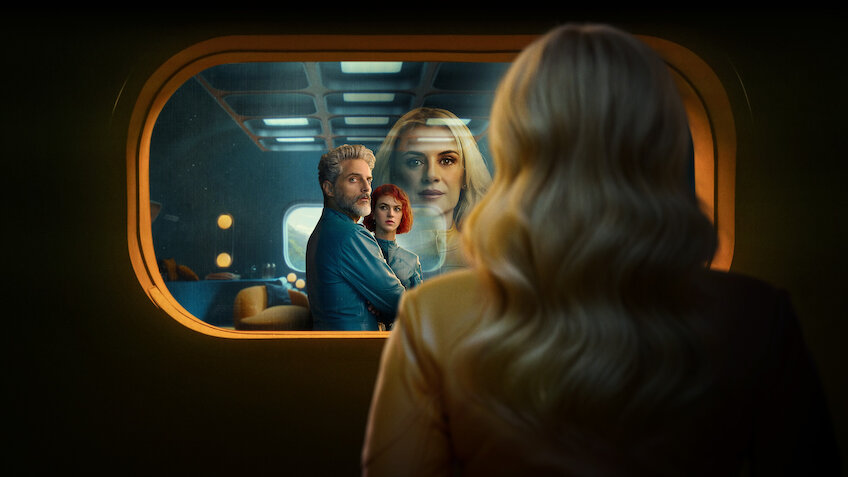

The new Spanish-language production Billionaires’ Bunker, originally titled El Refugio Atómico, has launched globally on Netflix. The eight-episode series is the latest project from creators Álex Pina and Esther Martínez Lobato, the creative force behind the internationally successful Vancouver Media productions Money Heist, Sky Rojo, and Berlin. The series advances a high-concept premise, positioning itself as a science-fiction thriller that examines a hypothetical World War III not from the front lines, but from the hermetically sealed comfort of a bespoke subterranean shelter designed for the ultra-wealthy.
A Gilded Cage at the End of the World
The narrative architecture of the series is constructed around a singular, claustrophobic setting: Kimera Underground Park. As global conflict escalates on the surface, a select group of multi-millionaires retreats to this technologically advanced fallout shelter, a self-sufficient subterranean city engineered to sustain more than 100 guests for up to a decade. The facility is less a bunker in the traditional sense and more a replication of an elite lifestyle, designed to be aspirational rather than oppressive. It is replete with amenities such as a basketball court, a fully staffed restaurant, a zen garden, a cocktail bar, a gymnasium, a spa, and even on-site psychological services. The class structure of the old world is meticulously preserved, symbolized by color-coded uniforms: blue for the owners and orange for the staff.


This meticulously designed environment, however, serves a deeply ironic narrative function. The inhabitants are able to watch the collapse of the world they once dominated on screens, viewing the apocalypse as a “bewildering spectacle.” The true conflict of the series is not the external cataclysm but the internal psychological and social implosion that occurs within this gilded cage. The central dramatic engine is a long-standing feud between two powerful families, whose unresolved history and deep-seated resentments are magnified by the forced cohabitation. The sanctuary, designed as the ultimate expression of privilege and control, rapidly devolves into an emotional prison. The series posits that no amount of technological sophistication or material luxury can insulate its characters from their own histories and moral failings; they have brought the seeds of their own destruction with them into their would-be utopia.
The Vancouver Media Signature: A Thematic Inversion
Billionaires’ Bunker is a distinct product of the Vancouver Media creative house and carries the recognizable authorial signature of Pina and Martínez Lobato. Their body of work is characterized by high-stakes, high-tension thrillers that often explore the psychological pressures of confinement and moral ambiguity. The series reunites a familiar creative team, including directors Jesús Colmenar and David Barrocal, who have previously helmed episodes of the creators’ other projects. The full writing team consists of Pina, Martínez Lobato, David Barrocal, David Oliva, Lorena G. Maldonado, and Humberto Ortega. The distinct visual palette is overseen by visual designer Migue Amoedo, another frequent collaborator, while the atmospheric score is composed by Frank Montasell and Lucas Peire. The creators’ stated goal was to create not just a story, but an immersive experience for the viewer.
However, the series also represents a significant thematic inversion of their most well-known work. Whereas Money Heist centered on anti-establishment figures waging war against a global financial system, Billionaires’ Bunker shifts its focus to the system’s ultimate insiders. By trapping the architects and beneficiaries of the old world order within a confined space, the narrative applies the creators’ pressure-cooker formula to the opposite end of the social spectrum. It moves the critique from an external assault on institutions to an internal dissection of the individuals who represent them, examining what remains of power and privilege when the world that conferred them ceases to exist.
An Ensemble Under Pressure
The series is fundamentally a character-driven psychological drama, relying on a strong ensemble cast to convey the narrative’s escalating tensions. The principal roles are filled by established Spanish and Argentinian actors. The cast is led by Miren Ibarguren, widely known for her extensive work in popular Spanish television comedies such as Aída and La que se avecina; Argentinian actor Joaquín Furriel, recognized for his dramatic roles in El reino and The Bronze Garden; Natalia Verbeke, with notable credits including the breakout film The Other Side of the Bed and the series Doctor Mateo; and Carlos Santos, a Goya Award winner for his performance in El hombre de las mil caras. They are joined by Montse Guallar, Pau Simon, Alicia Falcó, Agustina Bisio, and Álex Villazán. The performances are central to the series’ project of exploring the “subterranean violence” that emerges in the absence of societal norms. The narrative strips away the characters’ social masks, exposing their core ambitions, weaknesses, and long-buried secrets in an environment where wealth has become an abstraction and survival is the only remaining currency.
The Visual Architecture of a Mediated Reality
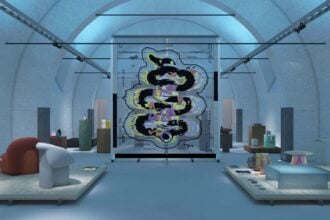
The production’s aesthetic is a critical component of its narrative. Migue Amoedo’s visual design eschews the grim, desaturated look typical of post-apocalyptic fiction. Instead, Kimera Underground Park is rendered as a bright, opulent, and meticulously designed space with a retrofuturist feel, drawing on the visual language of luxury hotels and Nordic design catalogues. This polished aesthetic creates a stark and unsettling contrast with the psychological decay of its inhabitants. A key element in achieving this immersive environment is the extensive use of virtual production technology. Filmed in part at Netflix’s production hub in Tres Cantos, Madrid, the series employed large-scale LED volumes to create realistic, 360-degree projections. This technical choice serves as more than a production convenience; it functions as a potent metaphor for the characters’ insulated existence. Amoedo developed a technique he calls “Aikido,” using the light from the LED screens themselves—bounced off mirrors—to illuminate the scenes, further blurring the line between the set and the projection. The production also utilized AI as a “preproduction accelerator” to generate concept art and create digital twins of real-world locations. This method mirrors the diegetic experience of its characters, reinforcing the theme of a life completely detached and mediated by technology.
A Contained World Reflecting a Fractured Present
Billionaires’ Bunker arrives as a notable entry in the genre of the contained thriller, which uses a microcosm to explore broader societal structures. While it shares a conceptual framework with series like Silo, its specific focus on the insulated lives of the ultra-wealthy offers a distinct and timely social critique. The series functions as a biting satire of elite privilege, tapping into contemporary anxieties surrounding global instability, extreme class disparity, and the “policrisis” of overlapping geopolitical and environmental threats. By dramatizing the real-world trend of billionaires constructing private survival shelters, the narrative feels less like distant science fiction and more like a direct extrapolation of the present. It is an allegorical work that suggests the most terrifying apocalypse is not the one that destroys the world, but the one that forces individuals to confront themselves in the ruins. The eight-episode series was released globally on the Netflix platform on September 19, 2025.