

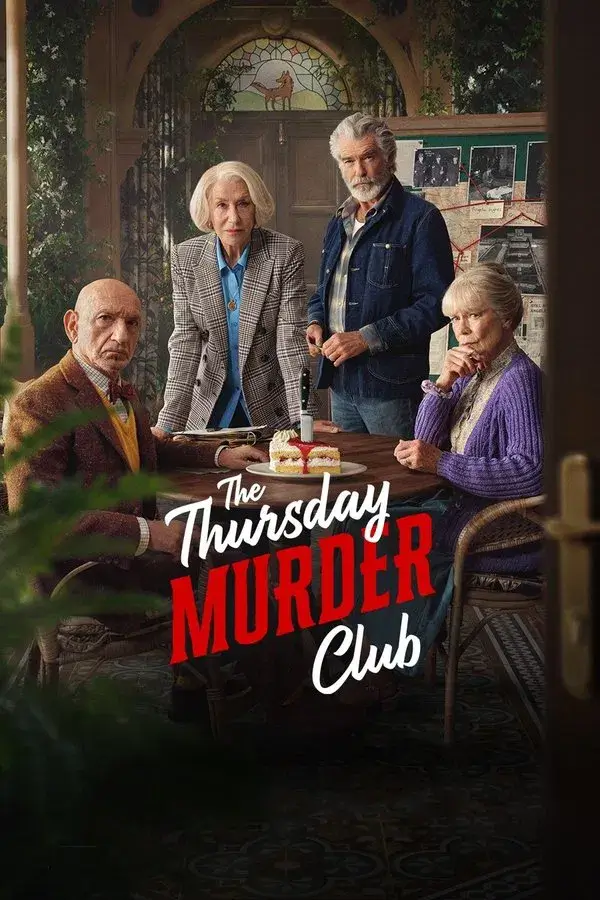

Adapted from Richard Osman’s bestselling novel, The Thursday Murder Club lands on Netflix as a precisely engineered “cozy” whodunit that trusts craft, ensemble performance, and procedural clarity over gimmickry. Directed by Chris Columbus and produced in partnership with Amblin Entertainment, the film translates a literary phenomenon into a streamlined screen narrative with clear geography, measured pacing, and an emphasis on character dynamics. The premise remains intact: four retirees at an upscale English retirement community turn their cold-case hobby into a live investigation when a local death exposes a tangle of motives. The tone is light without flippancy, and the film treats both mortality and community with unforced tact.
The ensemble is the organizing principle. Helen Mirren, Pierce Brosnan, Ben Kingsley, and Celia Imrie embody Elizabeth, Ron, Ibrahim, and Joyce with a combination of comic restraint and observational acuity. The film lets their complementary tempos do the narrative work: Mirren’s economy of gesture; Brosnan’s stubborn warmth; Kingsley’s analytic stillness; Imrie’s gently porous curiosity. The chemistry is functional rather than ornamental—lines overlap, pauses carry meaning, and the group’s rhythm makes interrogations feel like collaborative deductions rather than set pieces. Around them, Naomi Ackie and Daniel Mays provide a police counterpoint defined by procedure rather than condescension, while David Tennant, Jonathan Pryce, Richard E. Grant, Henry Lloyd-Hughes, Tom Ellis, Geoff Bell, Paul Freeman, Sarah Niles, and Ingrid Oliver populate a network of suspects and confidants that widens the field without sacrificing legibility. The casting extends beyond marquee value; each performer supplies a distinct vector of testimony, contradiction, or motive that advances the evidentiary chain.

Columbus keeps authorship proportional. His direction emphasizes actor-forward coverage, clean blocking, and a preference for spatial logic over emphatic visual punctuation. Scenes begin and end on thought rather than flourish. Dialogue is allowed to resolve naturally, with the cutting pattern favoring motivated reactions and matches on action that maintain the continuity of inquiry. The effect is closer to mid-century drawing-room mysteries than to modern pastiche; it resists the reflex to heighten when patience will suffice. In practical terms, that means clues are shown before they matter, misdirection emerges from credible behavior, and the solution reconfigures existing information rather than introducing late-stage contrivances. It’s a fairness doctrine applied to a popular form.


The technical departments align with that ethos of legibility. Don Burgess’s cinematography privileges readable geography—establishing lines, recurring vantage points, and selective depth of field that isolates relevant detail without ostentation. Interiors in Coopers Chase are lit with soft naturalism; exteriors make practical use of overcast skies to keep textures and edges clear. Dan Zimmerman’s editing respects conversational cadence and trims redundancy, particularly in interview sequences where over-insistence could telegraph outcomes. Thomas Newman’s score supplies connective tissue with recurring motifs that mark shifts from conviviality to inquiry without dictating emotion. Each choice preserves audience autonomy: the film invites inference rather than insisting on reaction.
Production design and costume undertake quiet narrative labor. Communal spaces show use rather than curated eccentricity; private rooms reflect their inhabitants through restrained color and object economy. Wardrobe avoids shorthand caricature—function over flourish for Elizabeth, layered utility for Ron, calibrated neutrals for Ibrahim, and measured warmth for Joyce. The cumulative effect is to anchor the characters in plausible daily life and to resist the genre’s frequent reliance on “quirky elder” costuming as personality proxy. In a story that depends on observation, this tactility matters; it grounds the deductions in a world that looks inhabited rather than staged.
As an adaptation, the film condenses a novel known for diary-like textures and multiple points of view into a two-hour framework without amputating its core interests: the friction and cooperation between institutional procedure and civilian initiative, and the way age confers methods that are undervalued by systems. Columbus and screenwriters Katy Brand and Suzanne Heathcote streamline peripheral threads and externalize interior monologue via action, gesture, and judicious insert shots. The humor arises from inference, not punchline mechanics, and the film maintains the book’s equilibrium—macabre events treated with proportion, friendship foregrounded without sentimentality. Osman’s involvement as executive producer is evident in the preservation of tonal balance and in the refusal to instrumentalize age either as punchline or as saccharine inspiration.
Crucially, the film treats its elderly protagonists as competent collaborators rather than narrative novelties. Their investigative tools—listening, institutional memory, patience with unglamorous tasks—form a counter-model to the hyper-competent detective archetype. The police are not straw antagonists; they adapt to the Club’s unorthodox contributions, and the investigation becomes a study in reciprocal respect. This design has cultural value. In a streaming environment that tends to favor high-concept escalation and youthful leads, The Thursday Murder Club demonstrates that intergenerational cooperation and local knowledge can organize a satisfying thriller without recourse to spectacle.

The film’s structure observes the genre’s “fair play” principle. Clues appear in plain sight; red herrings are motivated by character, not by authorial caprice; and the denouement privileges accountability over grandstanding. Viewers familiar with Golden-Age mechanics will recognize certain shapes—alibi testing, class-inflected motives, the dramaturgy of a final reveal—but the pleasure here is procedural: watching how Elizabeth, Joyce, Ibrahim, and Ron assemble meaning from fragments. The result is less about the shock of revelation than about the clarity of reconstruction, a form of satisfaction that survives rewatching.
Performance calibrations sustain this approach. Mirren locates authority in restraint, allowing the suggestion of a storied past without expository burden. Brosnan plays conviction rather than volume, which gives Ron’s confrontations an earned abrasion. Kingsley’s observational quiet—eyes doing diagnostic work—makes Ibrahim’s deductions feel like the product of method, not magic. Imrie’s timing refuses cutesiness, rendering Joyce an ethical center as much as a source of warmth. Among the supporting players, Ackie and Mays sketch a credible institutional context; Tennant, Pryce, Grant, Lloyd-Hughes, Ellis, Bell, Freeman, Niles, and Oliver articulate discrete strands of motive and opportunity that keep the suspect map legible.
From an industry perspective, the film is a logical alignment of assets. Netflix gains a recognizable literary IP with built-in global awareness; Amblin guarantees mainstream storytelling competence; and Columbus brings long-honed ensemble management. Formally, the project is calibrated for home viewing: the dialogue mix is forward; compositions favor mid-shots that read on a range of screens; momentum is maintained through scene purpose rather than action spikes. At catalog level, the title complements the platform’s darker thrillers with an adjacent register—witty, humane, procedural—that broadens the service’s mystery offering.
The credits reflect the same coherence. Columbus directs and produces; Jennifer Todd produces; the screenplay is by Katy Brand and Suzanne Heathcote; image, cut, and score come from Don Burgess, Dan Zimmerman, and Thomas Newman; production companies include Jennifer Todd Pictures, Maiden Voyage, and Amblin Entertainment, with Netflix as distributor. These details matter because they signal a preference for seasoned collaborators who understand classical narrative engineering—a mode that can look unfashionable until it quietly outperforms louder strategies.
What remains is the film’s cultural gesture: a refusal to flatten age into type. The retirees’ capacities—pragmatism, endurance, capacity to listen—become the engine of the investigation and the source of the comedy. The murder is not trivialized; it is contextualized within a community that understands consequence. The result is neither subversion nor comfort food. It is a competently made mystery, executed with proportion and tact, whose pleasures arise from clarity, performance, and the steady accretion of meaning.
Limited theatrical release begins August 22, 2025; streaming premiere on Netflix is August 28, 2025.