


Fantasy Football Ruined Our Lives (original title Ogni maledetto fantacalcio) follows a tight circle of friends whose fantasy-football rivalry collides with real consequences. On the morning of his wedding — which coincides with the decisive final matchday of their private league — Gianni fails to appear and, tellingly, never submits his lineup. The case lands before a dryly skeptical judge who questions Simone, a carefree screenwriter and Gianni’s closest friend, as the film unfolds in flashback. The interrogation becomes a narrative frame that parcels out the bachelor-weekend timeline, while messages, screenshots, and clipped photos from the group chat are treated as “exhibits,” turning habitual fan rituals into procedural comedy.
Federici’s direction favors economy and legibility over excess. The film alternates between the static severity of the questioning room and the volatile textures of party sequences, sustaining pace with clean transitions rather than frantic montage. Interface elements — overlays of chat threads, notifications, and cropped images — are integrated as visual motifs rather than gimmicks, situating the story inside the digital vernacular of contemporary fandom without sacrificing clarity. The screenplay by Giulio Carrieri, Michele Bertini Malgarini, and Roberta Breda keeps the stakes narrow and readable: loyalty, status in the league, and the etiquette of competition, refracted through a mystery that incrementally resolves without melodrama.
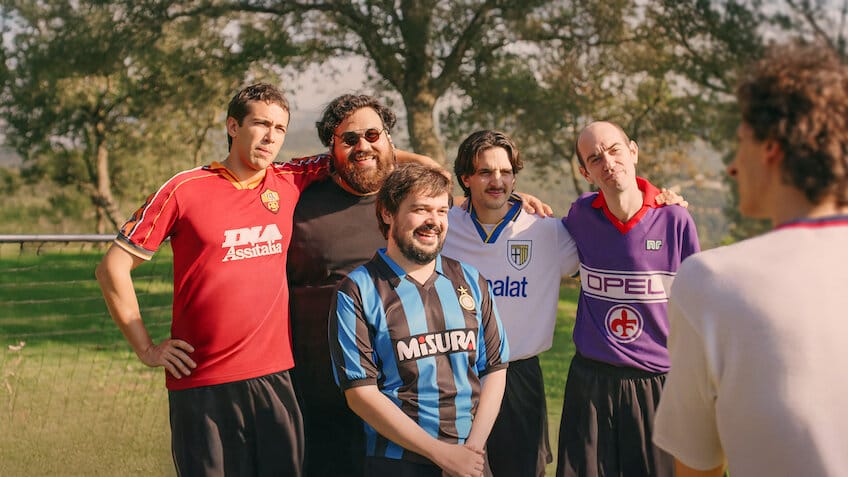
Performances are tuned to ensemble balance. Giacomo Ferrara plays Simone with measured, unforced timing that grounds the escalation. Silvia D’Amico lends Andrea — the league’s newest participant — a guarded, ambiguous poise that complicates group dynamics without tipping into caricature. Enrico Borello’s Gianni is mostly reconstructed through recollection and rumor, a choice that keeps the absent groom dramatically present while motivating the friends’ rivalries. Antonio Bannò and Francesco Russo sketch distinct, legible archetypes within the cohort, ensuring multi-handed scenes remain crisp rather than cacophonous. As the sardonic magistrate, Caterina Guzzanti supplies the film’s tonal metronome: laconic, procedural, and resistant to exaggeration, she lets the humor arise from framing and emphasis.



Formally, the picture reads as a buddy-mystery calibrated to sports-comedy cadence. Blocking is restrained, cutting patterns are functional, and the diegetic use of messaging sets a conversational rhythm that mirrors match-day chatter. When the narrative pivots toward explanation, it does so with pragmatic clarity: trivial clues are examined with crime-drama gravity, and ordinary missteps are inflated just enough to expose how a “game about a game” can format friendships, rules, and conflicts. Brief appearances from figures recognizable to Italian football audiences — including media personalities and a Serie A player and referee — punctuate the diegesis without overwhelming it, underscoring the porous border between spectator culture and everyday life on Netflix’s global platform.
Without sermonizing, Fantasy Football Ruined Our Lives articulates how competition, scorekeeping, and banter can become a grammar for friendship — sometimes productive, sometimes corrosive. It remains a comedy first: brisk, contained, and wary of overstatement, with a closing movement that resolves the disappearance cleanly and returns the characters to scale. For viewers accustomed to stadium-size sports spectacles, this is a chamber piece about fandom’s micro-politics, rendered with a light touch and a precise ear for how people actually argue about lineups.