

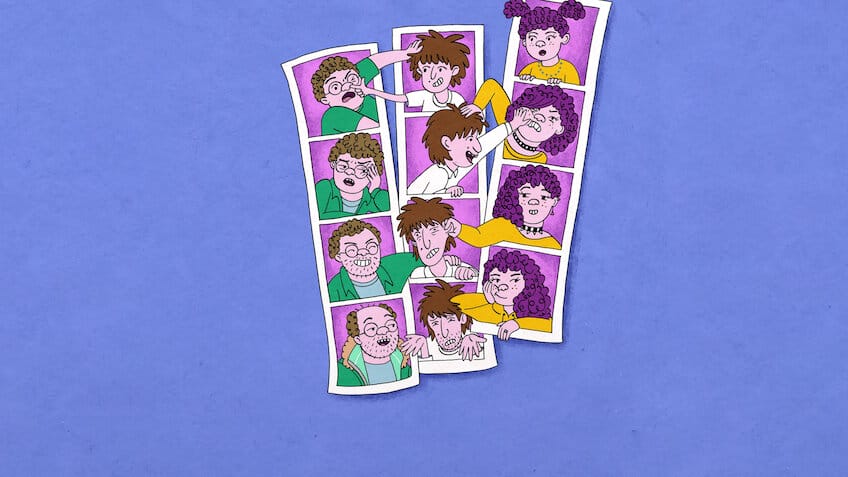

Netflix has premiered Long Story Short, an adult-animated series created by Raphael Bob-Waksberg, whose creative voice previously transformed the landscape of adult animation with BoJack Horseman. This ten-episode narrative unfolds the lives of the Schwooper siblings through a nonlinear timeline, intertwining past and present in a pattern that underscores how formative experiences echo throughout life.
Avi, Shira, and Yoshi Schwooper—voiced by Ben Feldman, Abbi Jacobson, and Max Greenfield—navigate adulthood while perpetually looping back to their childhood selves. Their dialogues, grounded and recognizable whether voiced by children or adults, reinforce a thematic truth: humor, identity, and relational patterns endure, impervious to the passage of time. This temporal interplay crafts an emotional immediacy, as if the viewer has tracked their lives over decades.
The voice cast extends beyond the siblings: Lisa Edelstein and Paul Reiser bring depth to their roles as parents Naomi Schwartz and Elliot Cooper. Angelique Cabral and Nicole Byer further enrich the ensemble, with Dave Franco and Michaela Dietz appearing in recurring capacities. Importantly, the primary characters are Jewish, voiced by Jewish actors—a deliberate choice that lends cultural authenticity to their mannerisms, humor, and narrative perspective without resorting to cliché.


Visually, Long Story Short embraces a hand-drawn 2D aesthetic imbued with rough lines and organic shading—an artisanal look that aligns with its thematic intimacy. By eschewing polished CGI, the animation conveys the imperfect warmth of family life. This visual direction, shaped by Bob-Waksberg in collaboration with supervising producer Lisa Hanawalt, is brought to life by ShadowMachine and The Tornante Company—continuing the creative lineage established during BoJack Horseman.
Tonally, the series pivots from satirical absurdity toward observational tenderness. Absent are high-stakes plot arcs in favor of quiet domestic tension: game-night rivalries, holiday misunderstandings, and evolving inside jokes become the emotional bedrock. These intimate vignettes accumulate into a textured narrative of shared history, where humor and emotional complexity coalesce in equal measure.
Premiered today, Long Story Short carries an aura of credibility rooted in its festival and production pedigree. It was featured at the Annecy International Animation Film Festival earlier this year, where it garnered attention for its narrative structure and character nuance. Netflix’s decision to renew the series for Season 2 prior to debut reflects institutional confidence in both the creator and the material.
In a domain where adult animation often leans into spectacle, Long Story Short distinguishes itself through narrative realism and cultural specificity. It illustrates how quotidian interactions acquire meaning over time, rendering memory, identity, and humor into compelling storytelling. By compressing a generational saga into a compact yet richly layered season, the series reaffirms that sincerity—rendered with creative restraint—can resonate more powerfully than grandiosity.
Long Story Short premieres on Netflix August 22, 2025.