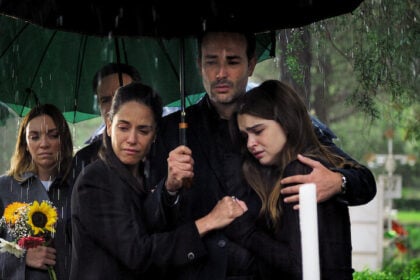



In the new Spanish series Death Inc., the death of Gonzalo Torregrosa, patriarch and founder of the Funeraria Torregrosa, creates a power vacuum that is anything but peaceful. His septuagenarian widow, Nieves, unexpectedly decides to assume control, assisted by her enthusiastic but clueless marketing-expert son-in-law, Chemi. This move thwarts the ambitions of Dámaso Carrillo, the founder’s loyal but scheming right-hand man, who believes he is the rightful heir to the business. As internal power struggles and corporate rivalries with the aggressive competitor Transitus unfold, a #MeToo-style scandal emerges, threatening to dismantle the fragile legacy of the deceased patriarch. The series masterfully transposes the universal tropes of the workplace comedy—scheming colleagues, inept management, corporate rivalry—into the taboo environment of the mortuary. This juxtaposition of the mundane with the macabre becomes a potent satirical lens, using the business of death to perform a clinical autopsy on the pathologies of modern life, from the emptiness of marketing-speak to the ruthlessness of corporate consolidation.
The Caballero Method: Auteurship in Contemporary Spanish Comedy
Behind Death Inc. are the sibling auteurs Alberto and Laura Caballero and their production house, Contubernio Films, architects of a distinct and commercially formidable brand of Spanish comedy. Their filmography, a pillar of modern Spanish television, includes cultural phenomena like Aquí no hay quien viva and La que se avecina, and the globally successful Machos Alfa. Their work is defined by a philosophical rejection of “comedia blanca,” or inoffensive “white” comedy. The Caballeros operate on the principle that comedy without risk is an amputated art form, a humor that fails to engage or provoke. They find a limitless wellspring of material in what they term “la miseria humana,” or human misery, believing it to be a universal and inexhaustible source of narrative. A consistent methodology is evident across their works: they construct a contained universe—an apartment building, a rural village, and now a funeral home—and populate it with a diverse ensemble of Spanish archetypes. This “pressure cooker” environment serves as a social laboratory where these characters, and the societal values they represent, are forced into collision. The funeral home is the ultimate evolution of this method, a space through which all segments of society must eventually pass, providing a constant and varied influx of narrative potential. The series also marks a strategic evolution for the streaming era. The creators have embraced a punchier 30-minute format, a conscious move away from the 70- to 90-minute episodes of their broadcast past that often necessitated narrative filler. This format, which proved successful with Machos Alfa, demands a more concentrated, joke-dense script perfectly suited to the binge-watching model of global platforms.




Anatomy of an Antagonist: The Centrality of Carlos Areces
The series is anchored by a masterful performance from Carlos Areces as the ambitious Dámaso Carrillo, a character who functions as both the primary antagonist and the narrative’s comedic engine. Areces’s unique comedic pedigree is essential to the show’s success. His career began in the influential “chanante” humor movement, a school of comedy defined by its surreal and absurdist sensibilities. He later honed his craft in the films of internationally acclaimed directors like Álex de la Iglesia and Pedro Almodóvar, grounding his absurdist tendencies within more structured narratives. This background is fused with a profound and long-standing personal fascination with mortality. Areces is a known collector of post-mortem photography and has published a book on the subject, approaching the topic from an intellectual and scientific perspective. This creates a unique meta-textual layer for the viewer; we are watching an actor who is a known aficionado of the very world the series depicts. His performance is a synthesis of absurdism and pathos. He portrays Dámaso as a credible, manipulative workplace threat while simultaneously imbuing him with a pathetic, almost ridiculous quality. He is a character who is both conniving and contemptible, yet his human foibles—envy, ambition, insecurity—are rendered with a comedic touch that makes him relatable even as he is repellent. Areces is the perfect vessel for the Caballeros’ complex tone, preventing the character and the series from descending into pure cynicism.
A Symphony of Misery: The Coral Ensemble at Work
While Areces is central, the series thrives as a “perfectly oiled machine” of coral comedy, its strength lying in the dynamic interplay of its full ensemble cast. The main characters are carefully constructed archetypes designed to generate conflict. Ascen López portrays Nieves, the underestimated matriarch whose quiet assumption of power subverts ageist and sexist expectations. Diego Martín plays Chemi, the avatar of modern marketing culture, whose absurd initiatives and empty jargon make him the natural antagonist to the traditionalist Dámaso. Amaia Salamanca embodies the sleek, aggressive competition as Vanesa, constantly conspiring to absorb the family business. And Roque Ruiz provides the audience surrogate as Morales, the naive intern whose innocence offers a stark contrast to the cynicism of the veteran employees. The interactions between these characters create a miniature society that reflects broader workplace dynamics, exploring themes of generational clashes, the battle between traditional practices and disruptive innovation, and the corrosive effects of unchecked ambition. The dialogue-driven scenes, particularly the ensemble moments that actors admit often devolve into laughter on set, are the primary stage for these thematic explorations.
The Aesthetic of the Afterlife: Production Design and Cinematography
The series’ thematic concerns are reinforced by a sophisticated and deliberate visual language, crafted by a technical team that includes Director of Photography Juan Luis Cabellos and Art Director Edu Vallejos. The creators made a conscious choice to “dignify” the visual presentation of their comedy, notably through the use of a wider, more cinematic aspect ratio. This is a significant departure from the flatter, more brightly lit aesthetic of traditional television sitcoms. This aesthetic choice is a statement of artistic intent, visually signaling that Death Inc. aims to be prestige comedy, on par with high-end drama, and reinforcing the philosophy that comedy is a serious art form capable of tackling profound subjects. The wider frame allows for more elegant and complex compositions, especially in the ensemble scenes, placing characters within their environment in a way that enhances the visual storytelling. This is complemented by a production design that externalizes the show’s central conflict of tradition versus modernity. The Funeraria Torregrosa is rendered with a classic aesthetic of dark woods and somber decor, evoking history and ritual, which is visually contrasted with the implied cold, impersonal modernism of the rival company, Transitus.
A Global Undertaking: The Series’ Journey to a Worldwide Audience
The journey of Death Inc. to a global audience exemplifies a powerful emerging model for Spanish content. The series originated as a commission for the Spanish streaming service Movistar Plus+, where it first aired and garnered critical acclaim, including a Feroz Award nomination for Best Comedy. Subsequently, Netflix acquired the global rights, a move that mirrors the successful distribution strategy of the Caballeros’ previous hit, Machos Alfa. This “incubator to megaphone” pipeline, famously successful with La Casa de Papel (Money Heist), allows domestic platforms to develop high-quality, culturally specific series. Once a show proves its appeal in the Spanish market, a global giant like Netflix can acquire it for worldwide distribution, minimizing development risk while providing a proven product for its vast international audience. Death Inc. is a testament to the success of this strategy, representing a high-water mark for Spanish comedy’s global reach and the universal appeal of a well-crafted story that finds humor in the darkest corners of human experience. A fourth season is reportedly already written, contingent on the series’ performance in its new global home.
The first two seasons of Death Inc. became available for global streaming on Netflix on July 31. The third season will premiere exclusively on the platform worldwide on August 21.