
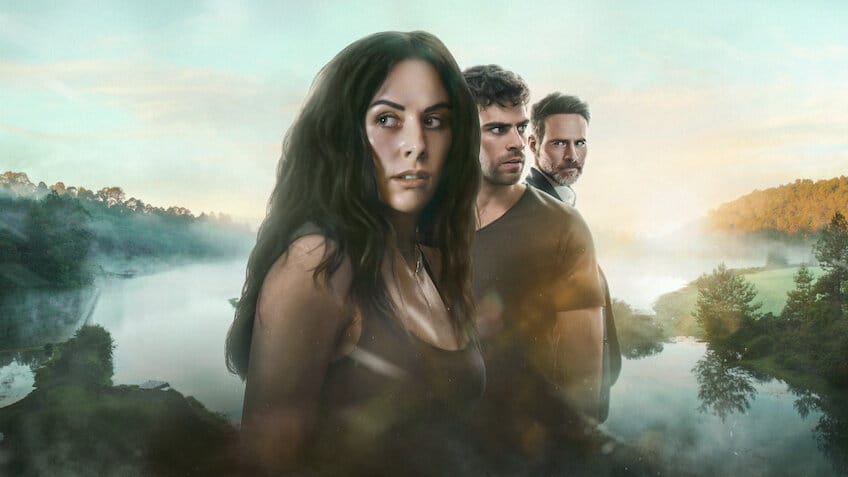

The global streaming platform Netflix has launched Unspeakable Sins (Original title: Pecados inconfesables), a new Mexican-produced series that situates itself within the erotic thriller genre. The narrative centers on Helena Rivas, portrayed by Zuria Vega, a high-ranking CEO of a transnational corporation who finds herself ensnared in a psychologically oppressive and controlling marriage to Claudio Martinez, played by Erik Hayser. Seeking an escape and a measure of retribution, Helena initiates a clandestine affair with Iván, a younger man depicted by Andrés Baida, who operates as a high-class escort. The central conflict is ignited when Helena devises a plan to extricate herself from her abusive situation by enlisting her lover’s help. The scheme involves creating a sexually compromising video of Claudio to use as leverage. However, the plot rapidly escalates beyond a personal vendetta into a high-stakes criminal investigation when Claudio vanishes without a trace. This sudden disappearance immediately casts Helena as the principal suspect, plunging her into a perilous and intricate web of deceit, betrayal, and long-buried secrets that threaten to consume her. The series is constructed as a multi-layered narrative, blending the core tenets of a thriller with pronounced elements of drama, mystery, and romance, all pivoting on the central axis of a kidnapping and disappearance case.
Narrative Architecture and Thematic Concerns
The dramatic structure of Unspeakable Sins is built upon a complex interplay of power dynamics, psychological manipulation, and vengeance, themes that are explored through a narrative lens focused on moral ambiguity and the hidden interests of a privileged social class. A deeper deconstruction of the central conflict reveals a plot mechanism of considerable sophistication. The plan to neutralize Claudio is not a simple act of revenge but a highly calculated operation targeting a specific vulnerability. The trailer’s dialogue explicitly states that Claudio’s “weak point always has been the young men and the boys,” positioning Iván as the perfect instrument for this calculated entrapment. This detail fundamentally alters the narrative’s ethical calculus, shifting the protagonist’s actions from a desperate act of self-preservation to a premeditated and manipulative stratagem that mirrors the psychological control exerted by her abuser.


This complexity is further reinforced by a deliberate cultivation of character ambiguity, particularly around the protagonist, Helena. While the series initially frames her as a sympathetic victim, this perception is systematically challenged. A line from the trailer, “Elena is playing, socio,” serves as a direct narrative signal to the audience, suggesting that her motivations are not transparent and that she is an active, and possibly deceptive, agent in the unfolding events. This narrative choice complicates the traditional victim-perpetrator binary and points toward a sophisticated exploration of the psychological transformation that can occur in response to prolonged abuse. The series appears poised to investigate the moral compromises inherent in seeking justice outside of established systems, potentially charting Helena’s evolution from a victim into an anti-heroine who adopts the very tactics of manipulation she seeks to escape. This approach allows the narrative to subvert conventional genre tropes, moving beyond the archetypes of the femme fatale or the “woman in peril” to construct a more nuanced and psychologically dense character study.
Beyond its character-driven core, the series embeds its story within a distinct socio-political subtext. The narrative unfolds against the backdrop of Mexico’s powerful corporate and political elite, suggesting that the “unspeakable sins” of the title extend beyond personal transgressions to encompass the systemic corruption and moral decay festering within these insulated circles. The thriller framework thus functions as a vehicle for social critique, examining how wealth, power, and influence are leveraged to conceal and perpetuate abuse, creating a world where accountability is a commodity. This is intrinsically linked to the pervasive theme of secrecy and the erosion of trust. The paranoid atmosphere of the series is established through dialogue that questions the very foundation of familial loyalty, as exemplified by the line, “Why do they have so many secrets in this shit family?”. Furthermore, the explicit distrust directed at a secondary character named Libia (“There’s something in Libia that I don’t trust”) reinforces a narrative world where every relationship is suspect and every character is a potential conspirator, ensuring that the mystery operates on both a public, criminal level and a private, interpersonal one.

The Creative Directorate: A Proven Assembly
The series is the product of a carefully assembled creative team whose collective experience indicates a deliberate and strategic production philosophy. The primary creators are the writing duo Leticia López Margalli and Guillermo Ríos, whose collaborative history includes the screenplay for the commercially successful film Instructions Not Included. López Margalli’s involvement is particularly significant; as an award-winning writer whose accolades include a Silver Goddess for Best Screenplay, and as a creator for Dark Desire, she was instrumental in developing one of Netflix’s most successful global erotic thrillers. Her filmography, which also includes complex, female-centric mystery and drama series such as Triptych and the acclaimed prison drama Capadocia, establishes her as a specialist in the narrative territory Unspeakable Sins aims to explore. Guillermo Ríos shares a credit on Capadocia and has also directed intense, character-focused projects like the film Perras, demonstrating a complementary sensibility for high-stakes storytelling.
The directorial duties are shared by Pablo Ambrosini and Felipe Aguilar D.. The selection of Aguilar D. is a noteworthy decision that hints at the series’ visual ambitions. His professional background is not primarily in commercial genre television but is deeply rooted in documentary filmmaking and visual experimentation. His stated artistic interest lies in exploring “the unexpected and the overlooked,” utilizing emerging technologies like Augmented Reality and Spatial Computing to create layered viewing experiences. Viewing art as a “revealing agent,” his approach suggests a directorial style that values authenticity and may serve to ground the thriller’s more stylized and dramatic elements in a tangible reality.
This pursuit of a distinct visual identity is further solidified by the hiring of Jeronimo Rodriguez-Garcia as the director of photography. A member of the prestigious Mexican Society of Cinematographers (AMC), Rodriguez-Garcia’s participation provides a crucial link to a proven aesthetic formula, as he also served as the cinematographer for Dark Desire. His body of work includes other visually sophisticated productions like The Game of Keys, and his creative philosophy—”Let the light be the way you feel the life, do it as an act of faith”—points to a commitment to expressive, rather than purely functional, lighting. His technical proficiency, including advanced techniques for achieving rich black-and-white tonality from color digital footage, suggests that the series will feature a carefully crafted visual grammar designed to elevate its narrative and emotional impact. The convergence of these specific talents points to a hybrid production model. The core creative team behind the writing and cinematography is drawn from the commercially successful template of Dark Desire, ensuring the series is built on a narrative engine of plot, pacing, and eroticism designed for mass appeal. Simultaneously, the inclusion of a director with an auteurist, documentary-style background suggests a deliberate effort to infuse this commercial framework with a more artful and visually distinctive sensibility. This fusion represents a calculated evolution in Netflix’s content strategy for the region, aiming to create a product that can satisfy the demands of a broad, binge-watching audience while also garnering critical appreciation for its sophisticated visual storytelling.
Ensemble Performance and Characterology
The series is anchored by a trio of principal actors whose casting appears to be a strategic decision designed to maximize its demographic appeal and thematic resonance. The lead role of Helena is played by Zuria Vega, a highly regarded and versatile actress in the Mexican entertainment industry. An award-winning performer recognized with a TVyNovelas Award for Best Female Revelation early in her career, her extensive filmography encompasses both widely popular telenovelas, such as Alma de hierro and Mar de amor, and critically noted contemporary series like ¿Quién lo mató? and La venganza de las Juanas. Her presence lends immediate credibility to the project and provides the dramatic weight necessary to navigate Helena’s complex psychological trajectory from victim to manipulator.
Playing opposite her as the controlling husband, Claudio, is Erik Hayser. Also a writer and producer, Hayser’s casting creates an immediate form of genre shorthand for the audience, given his prominent role in the thematically similar Netflix hit Dark Desire. This association helps to quickly establish the series’ tone and pedigree. His work in political thrillers like Ingobernable and Preso No. 1 further informs his portrayal, equipping him with the persona of a powerful and corrupt figure accustomed to wielding influence. The role of the young lover, Iván, is filled by Andrés Baida. His casting is a clear strategic move to engage a younger, global audience. Baida is a familiar face to Netflix subscribers through his key roles in the platform’s successful teen-oriented thrillers Control Z and Who Killed Sara?. His involvement serves as a bridge, connecting this adult-oriented thriller to the lucrative young adult market that Netflix has cultivated.
This casting strategy serves a dual function that extends beyond marketing. The on-screen dynamic of an established, powerful older woman (Helena) forming a transactional and passionate alliance with an ambitious younger man (Iván) is directly mirrored by the off-screen assembly of the cast. Vega and Hayser represent the established, veteran talent with deep roots in the Mexican television landscape, while Baida represents the new generation of stars forged in the global streaming ecosystem. The casting, therefore, functions as a meta-commentary on the series’ own themes of power, leverage, and the intersection of established influence with youthful appeal. The production is further strengthened by a robust supporting ensemble that features special appearances by highly recognizable actors Adriana Louvier, Eugenio Siller, and José María Torre, adding layers of prestige and intrigue to the world of the series. The full cast list also includes accomplished performers such as Manuel Masalva, Ana Sofía Gatica, Mario Morán, and Ivonne Montero, indicating a commitment to populating the narrative with a deep bench of talent capable of adding texture and complexity to the central mystery.
Production and Distribution Framework
Unspeakable Sins is a Mexican production from Mar Abierto Productions, with global distribution handled by Netflix. This places the series as a significant title within the streaming platform’s ongoing and substantial investment in original Spanish-language content, particularly from Mexico, which has become a vital international production hub. The first season of the series is structured as an eight-episode arc, a format conducive to binge-watching and narrative density. The executive production team includes Roberto Stopello, Mariana Iskandarani, and Willy Quiroga, who oversee the project’s execution.
The series’ musical identity is anchored by a new rendition of the classic song “Hoy Tengo Ganas De Ti,” performed for the soundtrack by Maria Leon and Yahir. The song was originally composed and popularized by the late Spanish singer-songwriter José Miguel Gallardo Vera, a prominent figure in Latin music during the 1970s and 1980s. The selection of this iconic and intensely romantic ballad as a thematic touchstone for a dark, cynical, and sexually charged thriller is a deliberate and tonally complex artistic choice. This juxtaposition of sound and narrative can be interpreted in several ways: it may function as an ironic counterpoint, highlighting the chasm between idealized romance and the brutal realities of the characters’ relationships; it could serve to underscore a genuine, if ultimately doomed, passion that exists amidst the betrayal and manipulation; or it may act as a powerful commercial hook, leveraging the nostalgia and emotional resonance of a beloved song to draw in a broader audience. Regardless of its primary function, this musical choice adds a significant layer of tonal ambiguity to the series’ overall presentation. Unspeakable Sins premieres on the Netflix platform on July 30, 2025.