

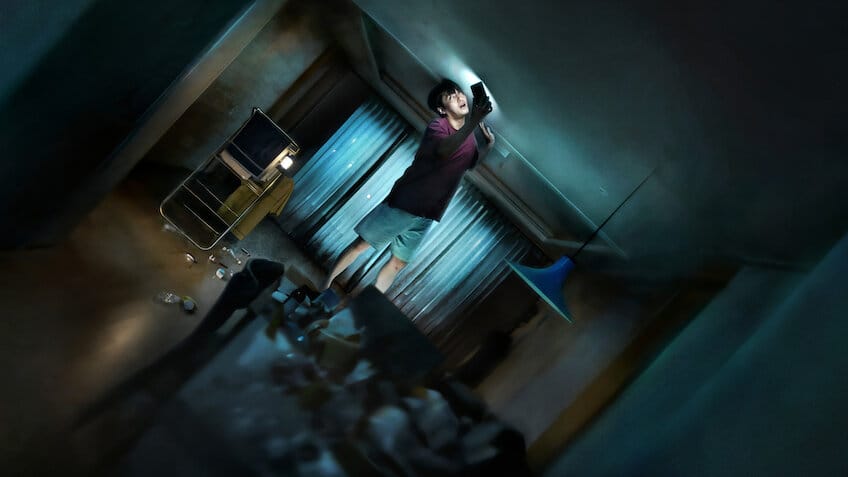

Netflix’s latest South Korean offering, Wall to Wall, is a thriller that transforms the universal dream of homeownership into a psychological nightmare. The film centers on Woo-sung, an ordinary salaried employee who achieves a life milestone by purchasing his own apartment. His initial joy is short-lived, however, as his sanctuary is invaded by mysterious, untraceable noises from neighboring floors. The nightly disturbances quickly erode his peace, plunging him into a state of distress and fraying his nerves. The conflict escalates when Woo-sung’s attempts to locate the source of the sound are met with denial from his neighbors. The situation takes a paranoid turn as he becomes the primary suspect, with anonymous notes appearing on his door accusing him of being the culprit. This social ostracization forces him on a desperate quest to prove his innocence, an investigation that draws him deeper into the unsettling secrets of the apartment complex and a nearby murder. His ordeal is shaped by interactions with two other central figures: Eun-hwa, the building’s powerful resident representative, and Jin-ho, a suspicious but empathetic upstairs neighbor. The film inverts the traditional haunted house trope; the source of terror is not a supernatural entity but an ambiguous, mundane, yet maddening reality. The horror stems from the erosion of sanity and security within a space that is supposed to represent safety and achievement.
A Portrait of a Generation at the Breaking Point
At the heart of the conflict is Kang Ha-neul’s portrayal of Woo-sung, a character designed as a portrait of a generation. He is a member of the “Young-gle” cohort, a term for young people who pull together every available resource to buy a home. To acquire his apartment, Woo-sung exhausts his mortgage loans, severance pay, personal savings, stock investments, and even sells his mother’s land. This sacrifice makes his subsequent psychological decline all the more poignant. The film charts his transformation from a hopeful man to someone increasingly sensitive, frail, and worn down by the incessant noise and mounting stress. Kang, who felt himself “weakening while filming,” discussed at length with the director how to portray a person pushed to an extreme breaking point, noting he’d never played a character who breaks down to such an extent. Director Kim Tae-joon cast Kang specifically for this role, believing the actor’s inherently bright and positive image would lend sympathy to a character who could otherwise become unrelentingly dark, thereby making this depiction of youth’s pain and desires more relatable.



Counterbalancing Woo-sung’s struggle is Yeom Hye-ran as Eun-hwa, the resident representative who operates from a luxurious penthouse, immediately establishing a class and power differential. While her official role is to maintain peace, her true nature is that of an ambiguous power broker. A former prosecutor, Eun-hwa is cold, calculating, and knowledgeable about navigating, and evading, the law. She represents the institutional forces governing the complex, with her priorities appearing to be the maintenance of property values—particularly with a major transit installation planned nearby—rather than justice for a single resident. Yeom Hye-ran portrays her with a cynical smile and an exterior of supportive kindness that hides a deep-seated ambition, embodying a detached elite that is part of the system but not a true neighbor.
The third point of this triangle is Jin-ho, the upstairs neighbor played by Seo Hyun-woo. Initially presented as intimidating and suspicious, his character arc evolves from that of a potential antagonist to an empathetic ally. Jin-ho is also a victim of the noise and, feeling a sense of pity and kinship, becomes a passionate partner in Woo-sung’s search for the source. To prepare for the role, Seo Hyun-woo, who was coincidentally experiencing noise issues himself when he received the script, underwent a physical transformation. The director sought the physique of a “fighter who has been through a lot,” not a conventionally muscular body. Seo gained weight and trained in boxing and judo to deliver impactful action sequences, adding a layer of authenticity to this complex character who bridges the gap between victim and protector.
Crafting Terror from Everyday Life
Director Kim Tae-joon specializes in what can be described as “reality-based thrillers,” finding horror in the anxieties of everyday life. This film is a direct thematic successor to his successful debut, Unlocked, which explored the fear of smartphone hacking. Wall to Wall was born from the director’s own severe experience with inter-floor noise while working on his previous project. This personal connection fueled his desire to create a timely and relatable story for the majority of South Koreans who live in multi-family housing. His approach to the film’s craft was meticulous. He paid deep attention to the sound design, aiming to capture realistic daily noises without making the auditory experience unbearable for the audience. The goal was to find a balance where the disturbances function as a “cinematic sound,” a narrative device with controlled intensity that builds suspense rather than simply grating on the nerves. Visually, Kim treated the apartment itself as a character. He faced the challenge of making a uniform, narrow space cinematically interesting. By using lighting and other elements, he ensured the environment was not static but reflected the changing emotional states of its tenants. In Woo-sung’s unit, for instance, lighting is used to cast bar-patterned shadows across the walls, visually reinforcing the sense that his dream home has become a prison.
The Weight of 84 Square Meters
The film’s Korean title, 84 Jegopmiteo, translates directly to “84 Square Meters”. This specific size is not arbitrary; it is the “gukmin pyeonghyeong,” or “national standard size,” for apartments in South Korea. It is the most common and popular layout, typically offering three bedrooms and two bathrooms, and has become a powerful symbol of achieving the middle-class dream. For many, owning an 84-square-meter apartment represents stability, success, and a proper family life. The director has noted that this concept of a “national standard” apartment is a uniquely Korean cultural phenomenon, and he chose it as the title because the number itself encapsulates the nation’s distinct apartment culture and the collective desires embedded within it. Woo-sung’s struggle is therefore not just to buy a property but to attain this culturally significant symbol. The film uses this icon of aspiration as a Trojan horse, presenting a universally understood ideal only to deconstruct it from within, revealing this symbol of stability to be a fragile and isolating cage.
A National Conflict on Screen
Wall to Wall taps directly into a significant and ongoing social issue in South Korea. The vast majority of the country’s population resides in multi-family housing, with apartments making up over 80% of these dwellings. This high-density living makes inter-floor noise a pervasive and serious source of conflict. The film’s premise is grounded in stark reality; in a recent 4.5-year period, there were nearly 220,000 civil complaints related to inter-floor noise, and in a single year, over 38,000 police reports were filed. The problem is so severe that it has escalated in some cases to acts of arson and murder, lending a grim credibility to the film’s high-stakes tension. The issue is significant enough to have prompted national-level intervention, including government regulations on noise standards for new construction and rules on minimum floor slab thickness, but the film dramatizes the gap between official policies and the lived experience of residents.
An Unsettling Reflection of Urban Anxiety
Ultimately, Wall to Wall is more than a simple genre piece. It is a layered narrative that uses the framework of a thriller to dissect the pressures of modern urban life. It weaves together themes of economic anxiety, the psychological toll of high-density living, the illusion of the middle-class dream, and the profound isolation that can exist even when surrounded by neighbors. Woo-sung’s journey, from hopeful homeowner to a man psychologically unraveling, is a chilling commentary on the price of aspiration. The film’s ending, in which Woo-sung returns to his apartment in Seoul, holding his property deed as the song “Seoul Eulogy” plays, offers a complex and unsettling resolution. It suggests the inescapable pull of the city and the dream it represents, even after that dream has proven to be a nightmare. Wall to Wall is a potent and timely film that finds terror not in the supernatural, but in the thin walls that separate us and the societal pressures that threaten to break them down.
The film has a runtime of 118 minutes and premiered on Netflix on July 18, 2025.