

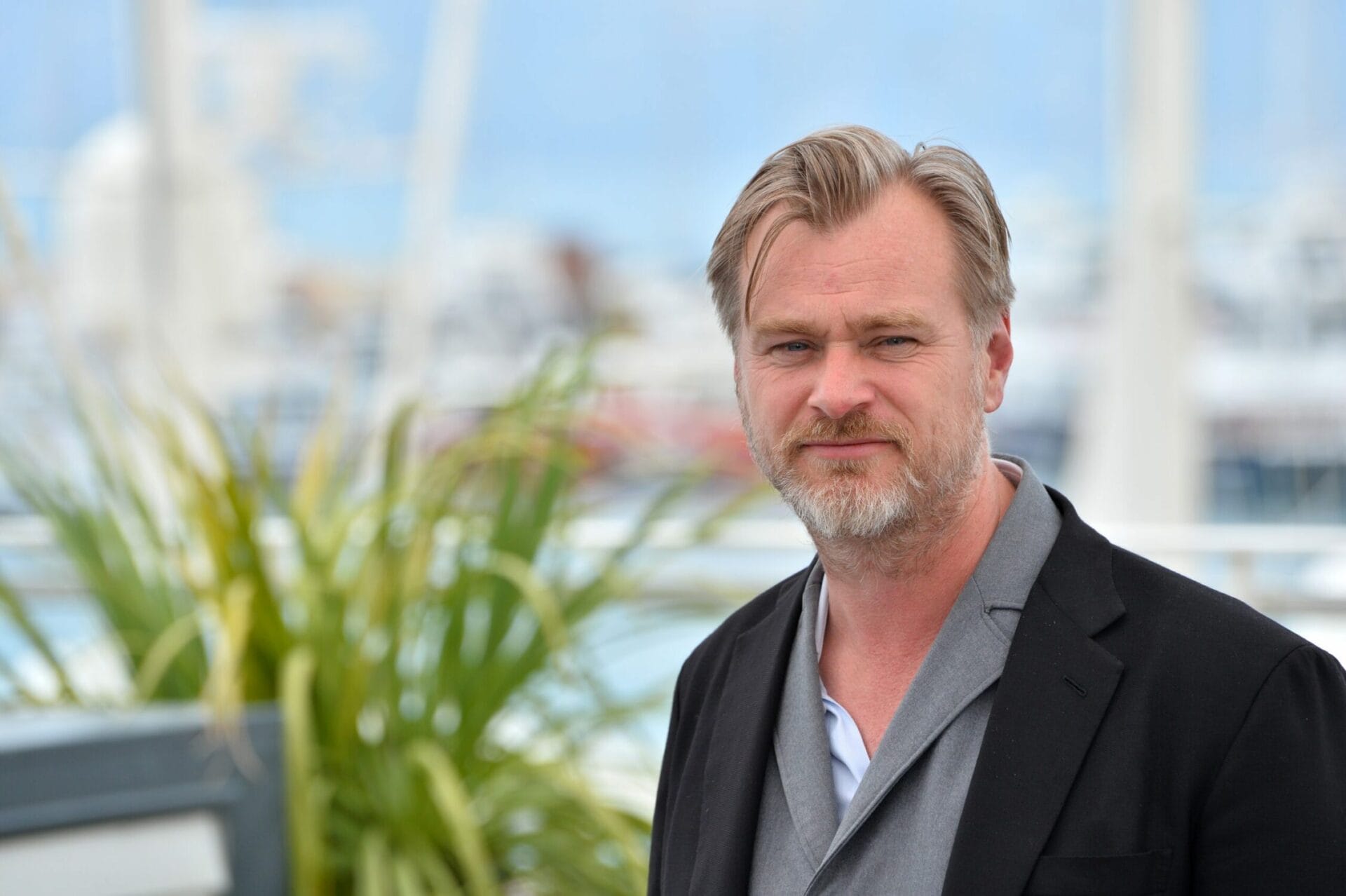
Christopher Nolan has developed one of contemporary cinema’s most distinctive professional identities: intricate narrative design, large-format image capture, practical effects on an operatic scale, and a devotion to the theatrical experience. Over nearly three decades, his filmography has reframed what a global event movie can be—intellectually ambitious, technically exacting, and built for big screens—while maintaining broad audience appeal. This biography focuses on Nolan’s professional evolution from weekend noir experiments to Academy Award victories, examining the methods, collaborations, and decisions that define his work.
Early Formation and a First Feature: Precision Born of Constraint
Nolan’s filmmaking grammar emerged from small crews, limited film stock, and careful planning. Working in London with friends and collaborators, he treated pre-production as the decisive creative phase, where visual logic and editorial architecture were locked before cameras rolled. That discipline powered his first feature, Following (1998), a black-and-white neo-noir shot on weekends with a microbudget. The film introduced core Nolan elements: intersecting timelines, a protagonist caught in systems he barely understands, and a structure that withholds and reveals information with measured control. Constraint shaped clarity; the lack of resources forced the design of scenes that would cut together with maximum legibility. The festivals and critical attention for Following positioned Nolan as a director with an architect’s mindset.



Breakthrough by Structure: Memento and the Mechanics of Time
Memento (2000) turned Nolan from promising newcomer into a filmmaker whose formal choices were themselves a public talking point. By intercutting black-and-white sequences moving forward with color scenes presented in reverse order, the film aligned narrative chronology with the protagonist’s fragmented memory. The result was a thriller whose suspense derived as much from editorial logic as from plot revelations. Structure became theme; causality became character. The industry took notice of Nolan’s ability to convert conceptual frameworks into compelling cinema, opening pathways to larger studio projects without abandoning his emphasis on clear geography and precise cutting.
Transition to the Studio System: Insomnia and Proof of Reliability
With Insomnia (2002), Nolan made a controlled entry into studio filmmaking. Rather than attempting to reinvent the police procedural, he emphasized point of view, atmosphere, and moral ambiguity, managing established stars and a larger crew while delivering on schedule. The film affirmed that Nolan’s methods—pre-visualization, location-driven staging, and disciplined shot design—could scale. The success of Insomnia was a professional hinge: it proved that a director associated with formal experimentation could also meet the logistical demands of major studio production.
Sleight of Hand and Dual Obsession: The Prestige as a Craft Manifesto
Between franchise entries, Nolan advanced his interest in rivalry, sacrifice, and the price of mastery with The Prestige (2006). Interlocking diaries, staged performances, and parallel arcs yielded a study of obsession that doubled as a meditation on cinematic illusion. The movie reads like a professional credo: great feats require misdirection, collaboration, and the willingness to hide the mechanism without insulting the audience’s intelligence. The period setting let Nolan test large-format strategies and practical engineering in service of character rather than spectacle alone.
Reframing a Franchise: Batman Begins and the Procedural Superhero
Batman Begins (2005) restored credibility to a faltering brand by treating a comic-book icon through the lens of logistics, training, and civic infrastructure. Nolan mapped Bruce Wayne’s skills with granular specificity—how he fights, moves, and uses technology—then staged the action around those constraints. Gotham emerged as an industrial ecosystem rather than a stylized backdrop. By rebuilding myth from method, Nolan reoriented the modern superhero film toward cause-and-effect realism and moral consequence. The production initiated a series of durable collaborations, notably with production designer Nathan Crowley and composer Hans Zimmer, that would shape the sound and image of his films for years.
The IMAX Leap and a Cultural Flashpoint: The Dark Knight
The Dark Knight (2008) set a new expectation for event cinema. Nolan integrated 65mm IMAX cameras into centerpiece sequences, not as a novelty but as an extension of his realism: the larger negative delivered clarity, detail, and a feeling of presence that underwrote practical stunts and urban scale. The result was a crime epic whose tone and visual language transcended genre labels. IMAX was treated as an instrument, not a gimmick, and the film’s legible geography and tactile action became templates for a new blockbuster grammar.
Originality at Tentpole Scale: Inception and Global Proof of Concept
With Inception (2010), Nolan demonstrated that an original, high-concept film could command the same commercial space as a franchise sequel. Nested dream levels were made readable through crisp cross-cutting, production-design cues, and a ruleset that governed action while inviting interpretation. Practical effects—rotating corridors, large-scale builds, in-camera manipulations—grounded the spectacle in physics that editors could cut with conviction. The achievement was as industrial as it was artistic: audiences would embrace unfamiliar worlds when execution was precise and the promise of scale was kept.
Ending Without Exhaustion: The Dark Knight Rises and the Logic of Closure
The Dark Knight Rises (2012) concluded the trilogy by emphasizing consequence and civic stakes. The narrative explores attrition—physical, psychological, and social—while the filmmaking doubled down on large-format capture and complex practical set pieces. The trilogy articulated a fragile balance that influenced subsequent franchise management across studios: plan arcs with endpoints, protect tonal coherence, and allow each entry to interrogate a different facet of the mythology rather than loop familiar beats. Closure, not escalation for its own sake, became the governing principle.
Scientific Sublime: Interstellar and Feeling Time
Interstellar (2014) merged Nolan’s fascination with time and scientific inquiry into a maximalist audiovisual experience. Relativity operates as a narrative engine; cosmic scale serves as an emotional amplifier. Working with 65mm and IMAX film cameras, bespoke projection deliverables, and an emphasis on location work and miniatures, the production prioritized tactility. The film’s argument is that scientific ideas can be felt as much as explained, and that theatrical presentation—sound pressure, image size, material textures—translates abstraction into experience.
Compressed Warfare and Pure Cinema: Dunkirk
With Dunkirk (2017), Nolan distilled his approach into pure cinematic grammar. Three interwoven timelines—land, sea, and air—converge on a common climax, each with its own temporal scale. Dialogue is minimal; geography, sound, and montage bear the weight of meaning. IMAX is again an expressive tool, particularly in aerial sequences where clarity of horizon lines and cockpit spatial logic becomes the drama. The film’s editing and sound design function as narrative—the cut itself is the sentence—and the result is an unusually physical experience of historical survival.
Edge-Case Experiment Under Adversity: Tenet and Reversible Action
Released amid a turbulent global exhibition landscape, Tenet (2020) pushed Nolan’s temporal experiments to a mechanical extreme. Action is choreographed both forward and backward; practical sequences are staged twice to achieve opposing vectors; and set pieces are designed to read across divergent perspectives without dissolving into incoherence. The production reinforced long-standing preferences for analog capture and in-camera engineering while introducing new musical textures through composer Ludwig Göransson. The film formalizes a recurring Nolan principle: audience orientation is a resource that can be strategically spent and replenished to heighten engagement.
Prestige Biography as Epic: Oppenheimer and Institutional Recognition
Oppenheimer (2023) marked Nolan’s move to Universal Pictures and aligned creative terms with his theatrical priorities. The film compresses a complex historical record into a propulsive study of scientific brinkmanship, power, and accountability, employing custom-developed large-format black-and-white film alongside color to structure viewpoints. Visualizations of theoretical concepts rely on practical methods and restrained digital augmentation, keeping the imagery cohesive and tactile. The project became both a cultural event and a career apex, consolidating Nolan’s stature with top honors across major institutions and confirming that rigorous, formally assertive filmmaking can dominate awards seasons while reaching mass audiences.
The Nolan Method: Architecture First, Departments in Lockstep
Across projects, Nolan’s method is consistent. He treats writing and pre-production as phases where the finished film is effectively built on paper. Editorial rhythm is embedded in the outline; geography is charted to support legible action; and departments are tethered to a shared design document long before principal photography. Camera systems—especially 65mm IMAX and 65mm/70mm photochemical formats—are chosen for experiential reasons: resolution, color depth, and immersion that uphold practical effects. When digital visual effects are deployed, they are integrated as enhancements rather than foundations. The organizing belief is that tangible inputs produce credible outputs: real light on surfaces, real debris trajectories, real parallax for editors to shape.
Casting follows a similar logic. Ensembles are assembled for utility and texture, with an emphasis on performers who can calibrate acting to the constraints of large-format lenses and variable aspect ratios. Exposition is staged as action where possible; when spoken, it is embedded in urgent circumstances or dispersed across multiple vantage points. Themes—memory, identity, moral tradeoffs, responsibility for knowledge—recur, but each film is constructed as a discrete argument rather than an installment in a thesis.
Sound and Image Philosophy: Immersion Over Comfort
Nolan’s soundscapes are designed for density, dynamic range, and physical impact. Music and effects interact with environment to generate pressure, not just volume, while dialogue is treated as one instrument within the field rather than a layer always placed on top. In auditoriums equipped for full dynamic delivery, the intention is to translate scale into embodiment, paralleling how large-format images convert detail into presence. Visually, cinematographers Wally Pfister (through The Dark Knight Rises) and Hoyte van Hoytema (from Interstellar onward) prioritize legibility over coverage. Blocking is planned for camera placement; editorial patterns are built into staging; and variable aspect ratios—especially the tall IMAX frame—are deployed as semantic tools to emphasize environment, verticality, or discovery. Photochemical finishing and careful home-media mastering maintain a consistent texture across formats, reinforcing the identity of the work beyond its theatrical run.
Syncopy and the Producer’s Perspective
Nolan’s professional identity is inseparable from Syncopy, the production company he runs with producer Emma Thomas. The company exists to protect development cycles, preserve creative control, and ensure that resources match ambition. Nolan engages franchise properties only when latitude is contractually defined, a position underwritten by a track record of delivery and audience trust. The long-game strategy is simple: incubate ideas until the architecture is robust, then mobilize departments in concert to execute at scale.
Collaboration as Continuity
While frequently labeled an auteur, Nolan’s continuity depends on durable creative partnerships. Production designer Nathan Crowley’s industrial modernism defines many physical spaces across the films. Editors Lee Smith and later Jennifer Lame shape cross-cutting and tempo to carry viewers through temporal complexity without sacrificing tension. Composers chart the sonic identity of each era: David Julyan’s early austerity, Hans Zimmer’s propulsive textures and sustained harmonics, Ludwig Göransson’s experimental timbres aligned with reversible action. Special effects supervisor Chris Corbould and visual-effects collaborators such as Paul Franklin specialize in integrating practical and digital elements so that final images feel cohesive rather than composited. The system is collaborative by design; authorship emerges from alignment, not from isolation.
Business Choices That Reshaped Exhibition
Nolan’s public advocacy for premium theatrical presentation has had measurable industry impact. IMAX installations expanded alongside demand for large-format titles; distributors marketed 70mm engagements as events; and studios re-evaluated release windows and projection standards to court audiences who treat presentation quality as a reason to buy a ticket. His insistence on photochemical capture helped stabilize film-stock availability during periods of rapid digital adoption. The director’s move to Universal ahead of Oppenheimer confirmed a broader principle: release strategies and exhibition commitments are creative variables, not merely business terms. The marketplace learned that craft decisions—camera system, format, projection—can themselves be marketable.
Enduring Themes and the Audience Contract
Across noir, superhero epic, heist, science fiction, war, and biographical drama, Nolan returns to builders—characters who construct dreams, myths, weapons, or identities—and to the costs of that construction. Time is his favored lens: by distorting chronology or splitting perspective, he tests whether cause and effect are ethical categories as much as narrative ones. The recurring contract with audiences is clear: work is asked of them—attention, inference, patience—but the films repay that work with clarity in retrospect and with sensory immersion in the moment. Challenge is paired with payoff, and trust is earned by adherence to internal rules.
Influence on Filmmakers and Studios
Nolan’s impact is visible in both aesthetics and green-light math. Studios now position original tentpoles as viable counterprogramming to franchise cycles when they can be marketed around craft-centered spectacle. Younger directors cite the example of Inception, Dunkirk, and Oppenheimer when pitching structurally ambitious projects at scale. IMAX and 70mm have shifted from novelty to multiplex anchors on release calendars. Even in the streaming era, event-level theatrical runs are used to transform films into cultural touchpoints before their platform lives. By demonstrating that rigor sells, Nolan expanded the definition of what a mainstream hit can look and feel like.
Home Media, Mastering, and Preservation
Nolan’s involvement in home-media mastering reflects a preservationist mindset. Color timing, contrast, and aspect-ratio transitions are supervised to preserve intent across televisions and projectors, while high-bit-rate encodes and premium physical formats sustain the films’ visual density. Archival elements are maintained so that repertory screenings and educational contexts have access to high-quality materials. Presentation is not treated as an afterthought; it is part of the work’s identity and longevity.
Professional Legacy to Date
Measured by awards, influence, and audience turnout, Nolan’s career is already canonical. Measured by method, it is a sustained argument for cinema as a total design problem in which story, image, sound, and exhibition interlock. He has shown that major studios will back an idiosyncratic vision when audiences believe the experience cannot be replicated elsewhere, and that technical choices—from film stock to projection—still matter to the mainstream. The legacy is dual: a body of films that reward study and a production philosophy that others can adopt.
A Filmography in Motion: Through-Lines Across the Work
From Following and Memento to Insomnia, Batman Begins, The Prestige, The Dark Knight, Inception, The Dark Knight Rises, Interstellar, Dunkirk, Tenet, and Oppenheimer, Nolan’s titles exhibit continuity of purpose. Each film is designed around a central question: how should time be experienced here, and how can image, sound, and performance align to transmit that experience? The early noirs explore subjective recall and deception; the Batman trilogy examines institutional decay, escalation, and civic ethics; Inception explores layered reality and the engineering of belief; Interstellar refracts cosmic phenomena through familial stakes; Dunkirk translates national crisis into sensory immediacy; Tenet turns orientation into a game of reversible causality; Oppenheimer confronts the consequences of knowledge at state scale. Across them all, the project is constant: to make complexity legible and gravity thrilling without underestimating the audience.
Outlook
Nolan’s future projects will likely continue to prioritize theatrical presentation, long lead times for fine-grained coordination, and resource levels that match ambition. Premium formats, in-camera engineering, and collaboration with trusted department heads are expected to remain central. The industry will keep calibrating release calendars around his films, a real-time indicator of professional impact that extends beyond any single award or box-office milestone.
Why Nolan Matters—In One Line
Christopher Nolan proved that rigor itself can be thrilling, and in doing so he expanded the mainstream vocabulary of what cinema can be.