
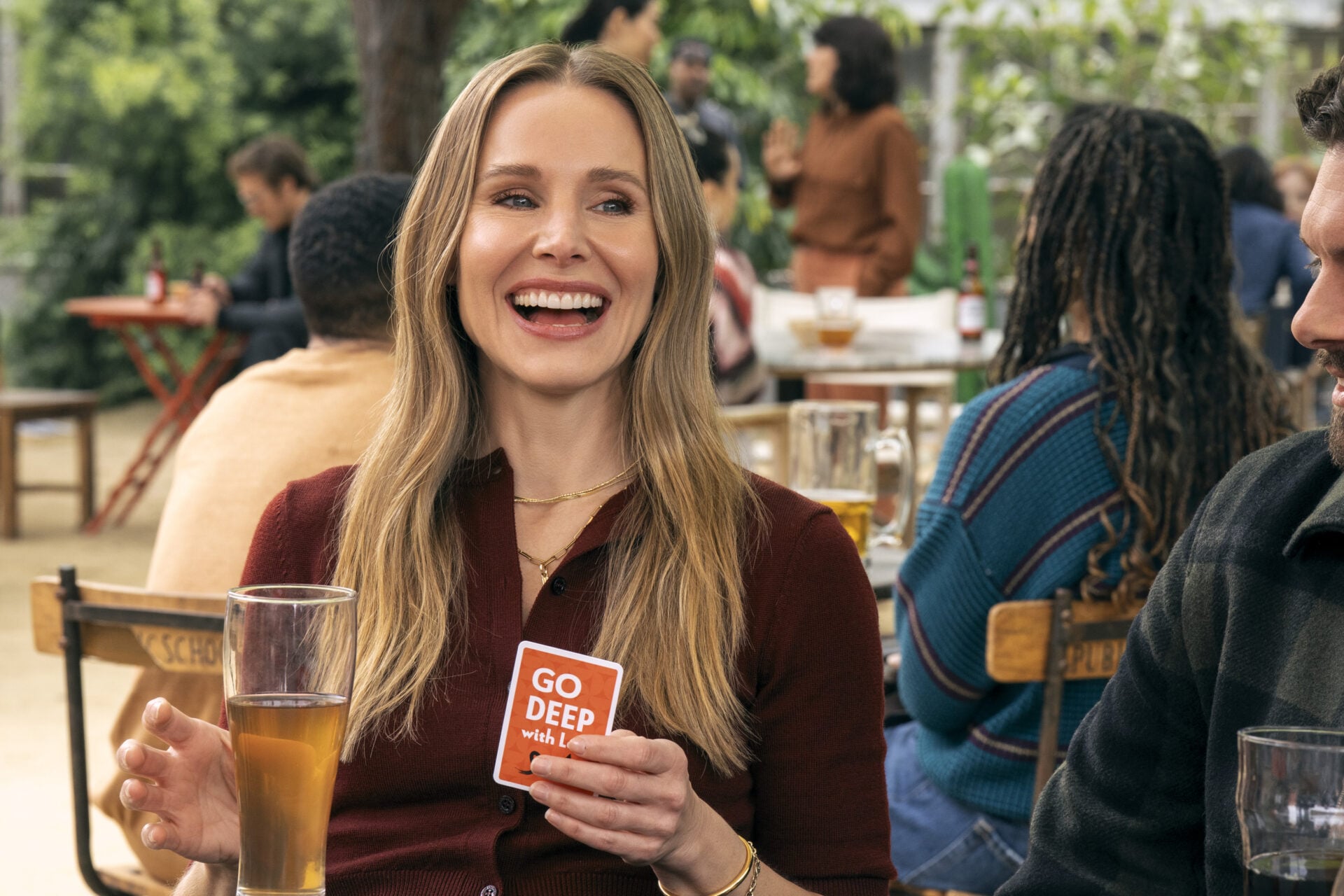

The Unconventional Protagonist
In an era of fleeting stardom, Kristen Bell has crafted a career defined by resilience, reinvention, and a rare authenticity that has made her one of Hollywood’s most enduring and relatable figures. Her latest success, the critically acclaimed Netflix romantic comedy Nobody Wants This, which earned her nominations for both a Primetime Emmy and a Golden Globe, is not an outlier but the latest chapter in a career built on smart, often unconventional, choices. For over two decades, Bell has navigated the industry not by following a predictable path, but by creating her own, moving seamlessly from the cult-classic teen noir of Veronica Mars to the global phenomenon of Disney’s Frozen and the philosophical comedy of The Good Place.
Yet, to define her by her acting roles alone would be to miss the larger picture. Bell has cultivated a parallel career as a savvy entrepreneur with the baby-care brand Hello Bello and as a formidable advocate for causes close to her heart, most notably mental health awareness and animal welfare. Her career is a masterclass in leveraging a public platform, demonstrating a consistent ability to pivot and redefine her image for new generations of audiences. She has not had one singular peak; rather, her trajectory is marked by a series of pivotal renaissances, each one building on the last, cementing her status not just as an actress, but as a significant cultural voice.
The Making of a Performer – From Michigan to Broadway
Born on July 18, 1980, in the Detroit suburb of Huntington Woods, Michigan, Kristen Anne Bell’s foundation was built on a blend of Midwestern practicality and nascent theatrical ambition. The only child of Lorelei, a registered nurse, and Tom Bell, a television news director, her early life was shaped by her parents’ divorce when she was a child. However, she has described this period not as one of instability, but of expanded love, as both parents remarried and remained close, providing her with a large, blended family of half-sisters and step-siblings. This supportive environment allowed her unique personality to flourish. At age four, she decided she preferred her middle name and went by “Anne” until high school.
Her artistic inclinations emerged early and in quirky fashion. In 1992, she made her stage debut in a community theater production of Raggedy Ann and Andy, tackling what she would later humorously call the “complex dual role of the banana in the first act and the tree in the second act”. Her mother helped her secure an agent, leading to parts in local Detroit-area commercials. She honed her craft at Shrine Catholic High School in Royal Oak, where she was active in the drama and music clubs, landing the lead role of Dorothy in a production of The Wizard of Oz.
After graduating in 1998, Bell moved to New York City to attend the prestigious Tisch School of the Arts at New York University, where she majored in musical theater. Her time at NYU was marked by a clear focus and a drive that would come to define her career. This professional ambition was put to the test in 2001 when a significant opportunity arose. A role in a new Broadway musical adaptation of The Adventures of Tom Sawyer became available, forcing a difficult choice. In a move that demonstrated a calculated prioritization of practical experience over traditional milestones, she left NYU just four credits shy of her degree to make her Broadway debut as Becky Thatcher. This was not an act of dropping out but a strategic career decision. The risk immediately paid off, as it was followed by another high-profile Broadway role in the 2002 revival of Arthur Miller’s The Crucible, where she performed alongside stage and screen legends Liam Neeson and Laura Linney. With two major Broadway credits to her name before she was even 22, Bell had laid a formidable foundation for her next move: Los Angeles.
The Neptune Noir – The Enduring Legacy of Veronica Mars
After relocating to Los Angeles in 2002, Bell landed a series of guest spots on established shows like The Shield, American Dreams, and Everwood. But in 2004, she secured the role that would define the first phase of her career and earn her a passionate, lifelong fanbase: the title character in the UPN series Veronica Mars. The show was a singular creation, a brilliant fusion of witty teen drama and gritty, hardboiled detective noir set in the fictional, class-divided town of Neptune, California. As Veronica, a cynical high-schooler moonlighting as a private investigator, Bell delivered a performance that was sharp, vulnerable, and wise beyond its years.
The series was a critical darling, beloved by reviewers who praised its complex season-long mysteries and Bell’s commanding presence, for which she won a Saturn Award for Best Actress on Television. Despite the acclaim, the show struggled with ratings on the smaller UPN and later The CW networks, leading to its cancellation after three seasons in 2007. For most shows, that would have been the end. But the story of Veronica Mars was far from over, thanks to its fiercely loyal audience. For years, both Bell and series creator Rob Thomas fielded constant questions from fans and journalists about a potential movie. The studio, Warner Bros., remained hesitant, unable to see the financial viability in a project whose core audience, while passionate, was not reflected in traditional broadcast metrics.
This impasse led to a groundbreaking moment in fan-creator dynamics. In 2013, Bell and Thomas launched a Kickstarter campaign to fund a Veronica Mars movie, posing a direct question to the fanbase: “Do you want to make this movie?”. The response was a strategic and data-driven repudiation of the old studio model. The campaign was designed as a proof-of-concept to demonstrate a quantifiable audience, and it succeeded beyond anyone’s wildest expectations. The initial goal of $2 million was shattered in under 11 hours, and the campaign ultimately raised over $5.7 million from more than 91,000 backers. This was not merely a fundraising effort; it was a disruptive event that proved a highly engaged niche audience could directly finance content, bypassing traditional gatekeepers and providing undeniable financial data that the studio’s models had missed.
The resulting film was released in 2014, followed by a one-season revival on Hulu in 2019. For Bell, the character of Veronica evolved from a role she felt an intrinsic connection to—once stating it “wasn’t acting at all” because they were so similar—into something more profound. After becoming a mother, she viewed the character’s existence as a cultural necessity. She framed her decision to return for the Hulu series as a choice made “as a mom,” willing to sacrifice personal time to ensure that this powerful, non-stereotypical female protagonist—a “force” and an “example”—existed in the world for a new generation of girls, including her own daughters, to reference.
Conquering Hollywood – The Leap to the Big Screen
While Veronica Mars cemented her television legacy, Bell simultaneously worked to build a presence in film. She earned praise for her role as a kidnapped presidential daughter in David Mamet’s taut thriller Spartan (2004) and reprised her stage role in the film version of Reefer Madness: The Movie Musical (2005). However, her definitive breakout film role arrived in 2008 with the Judd Apatow-produced romantic comedy Forgetting Sarah Marshall.
Cast as the titular Sarah Marshall, a successful TV actress who unceremoniously dumps her composer boyfriend (played by writer Jason Segel), Bell masterfully subverted the “good girl” persona she had cultivated on television. The role showcased her impeccable comedic timing and her ability to portray a character who was simultaneously selfish, vulnerable, and surprisingly human. The film was a critical and commercial success, grossing over $105 million worldwide and establishing Bell as a bona fide movie star.
The experience of making the film held a layer of profound, unscripted poignancy for Bell. In a moment of uncanny life-imitating-art, she received the official news that Veronica Mars had been canceled while on the set of Forgetting Sarah Marshall. The timing was surreal, as she was preparing to film a scene in which her character, Sarah, laments the cancellation of her own television show. Bell later described it as a “very meta moment,” where the lines between her own professional grief and her character’s fictional one blurred completely. This convergence of reality and fiction likely infused her performance with a raw, authentic emotional depth, transforming what could have been a one-dimensional antagonist into a more complex and compelling character.
The success of Forgetting Sarah Marshall opened the door to a string of leading roles in mainstream comedies. She starred alongside Vince Vaughn in Couples Retreat (2009), took the lead in the romantic comedy When in Rome (2010), and played opposite Christina Applegate and Mila Kunis in the hit comedies Bad Moms (2016) and its sequel, A Bad Moms Christmas (2017). Through these roles, she solidified her reputation as one of Hollywood’s most reliable and charming comedic actresses.
A Voice for a Generation – The Frozen Phenomenon
Alongside her on-screen work, Bell cultivated a prolific career as a voice actress, a path that would lead to her most globally recognized role. She was the sharp, omniscient narrator for the entire run of the popular teen drama Gossip Girl (2007-2012) and voiced the character of Lucy Stillman in the blockbuster Assassin’s Creed video game franchise. But in 2013, her voice became inseparable from a character that would capture the hearts of millions around the world: Princess Anna of Arendelle in Disney’s animated musical Frozen.
For Bell, a lifelong devotee of Disney animation who grew up singing The Little Mermaid into a tape recorder, landing the role was the fulfillment of a childhood dream. Her involvement, however, went far beyond a simple vocal performance. She was a fundamental force in shaping Anna’s character. From the outset, Bell had a clear vision for a more modern and relatable princess. She pushed for Anna to be imperfect, goofy, and awkward—someone who “talks too much and too fast” and doesn’t have perfect posture, a departure from the poised archetypes of the past.
The film’s creative team embraced her input, allowing her personality to infuse the character’s very DNA. Directors Jennifer Lee and Chris Buck noted that Bell “became Anna and Anna became her,” and animators took cues directly from her vocal recordings to craft Anna’s expressive and charming mannerisms. The result was a princess who felt refreshingly real. Frozen became a cultural touchstone, the highest-grossing animated film of all time upon its release, and its Oscar-winning soundtrack, featuring Bell’s heartfelt performances on songs like “For the First Time in Forever” and “Do You Want to Build a Snowman?”, achieved multi-platinum status. She reprised the role in the equally successful sequel, Frozen II (2019), as well as in several short films, cementing Anna of Arendelle as one of the most beloved animated characters of the 21st century.
The Afterlife and Beyond – A Television Renaissance
In 2016, Bell made a triumphant return to television as the lead in Michael Schur’s high-concept NBC sitcom, The Good Place. She starred as Eleanor Shellstrop, a selfish, morally bankrupt woman from Arizona who, upon her death, is mistakenly sent to a heaven-like utopia. The series, which ran for four critically acclaimed seasons, was a masterful blend of comedy and philosophy, following Eleanor’s hilarious and poignant journey to become a better person. The show was a critical sensation, earning a prestigious Peabody Award and numerous Emmy nominations. For her performance as the deeply flawed but ultimately redeemable Eleanor, Bell received widespread praise and a Golden Globe nomination for Best Actress.
Following the celebrated conclusion of The Good Place in 2020, Bell once again proved her staying power with the 2024 Netflix series Nobody Wants This. In the show, she plays Joanne, an outspoken, agnostic woman who finds herself in an unlikely romance with a progressive rabbi, played by Adam Brody. The series was an immediate hit with critics and audiences, praised for its sharp writing and the palpable chemistry between its leads. The role earned Bell another round of major award nominations, including her first Primetime Emmy nomination for Outstanding Lead Actress in a Comedy Series and a second Golden Globe nomination.
These two roles, arriving a decade apart, highlight a specific and successful niche Bell has carved out for herself. Both Eleanor Shellstrop and Joanne are spiritual successors to the archetype she first perfected in Veronica Mars: sharp-witted, cynical, and deeply flawed women navigating unconventional moral and social landscapes. Her continued success is built not on playing aspirational figures, but on embodying messy, relatable characters who challenge audience expectations and are, above all, human.
What’s Next for Joanne and Noah? – Nobody Wants This Season 2
The runaway success of Nobody Wants This led to a swift renewal, with the highly anticipated second season scheduled to premiere on Netflix on October 23, 2025. The new season picks up after the first season’s romantic cliffhanger, where Noah chose Joanne over his lifelong ambition of becoming head rabbi. Instead of manufacturing a cliché breakup, the creators have promised to explore the realistic and complex aftermath of that grand gesture.
Season 2 will delve into the day-to-day challenges of merging their two vastly different worlds. The central conflict will continue to revolve around their inter-faith relationship, Joanne’s potential conversion to Judaism, and how they navigate the pressures from Noah’s family and community. The season will also expand its focus to the supporting cast, with a significant storyline for Joanne’s sister, Morgan (Justine Lupe), and the introduction of new characters played by Seth Rogen and Leighton Meester—the real-life wife of Adam Brody.
The Business of Being Bell – Entrepreneurship and Advocacy
Kristen Bell’s influence extends far beyond the screen. She has strategically used her platform to build a successful business and champion causes with a passion that mirrors the conviction of her most iconic characters. This off-screen work is not a footnote to her career but a central pillar of her public identity, reflecting a consistent ethos of empathy and a desire to challenge established systems.
Hello Bello: The Mission for “Premium for All”
In 2019, Bell and her husband, Dax Shepard, co-founded Hello Bello, a company dedicated to providing plant-based, premium-quality baby-care products at affordable prices. The company’s mission, “Premium for All,” was a direct response to a market that often forces parents to choose between what is best for their children and what is best for their budget. Launching exclusively with Walmart to ensure broad accessibility, Hello Bello offered a range of products from diapers and wipes to sunscreen and laundry detergent.
Despite its strong mission and initial growth, the company faced significant financial headwinds. Citing high shipping and production costs, which were exacerbated by logistical challenges in setting up its own Texas-based diaper factory, Hello Bello’s parent company filed for Chapter 11 bankruptcy in October 2023. The move was designed to facilitate a sale, and in late 2023, the brand was acquired for a reported $65 million by Hildred Capital Management, a private equity firm. Now part of a larger portfolio that includes Hyland’s Naturals, Hello Bello is in a stronger financial position to continue its mission of providing affordable, premium products to families.
Mental Health Advocacy: Destigmatizing the Conversation
Perhaps her most personal and impactful advocacy has been in the realm of mental health. For years, Bell has spoken with unflinching honesty about her own lifelong struggles with anxiety and depression. Encouraged by her mother from a young age to seek help without shame, she has made it her mission to dismantle the stigma surrounding mental illness. In powerful personal essays and interviews, she has described depression not as sadness, but as a debilitating sense of isolation and worthlessness, arguing that mental health check-ins should be as routine as visiting a doctor for a physical ailment.
Her advocacy continues to evolve. In 2023, she became the first Mental Health Ambassador for the telehealth company Hers, promoting access to professional care. More recently, in October 2025, Bell and the USC Annenberg Inclusion Initiative announced the launch of the Mental Health Accelerator, a program offering grants to emerging filmmakers to create short films centered on mental health, with an emphasis on resilience and hope. In September 2025, she also took the stage at the Global Citizen Festival as a Global Advocate for the UN’s Women’s Peace & Humanitarian Fund.
Animal Welfare: A Lifelong Passion
Bell’s commitment to animal welfare is a lifelong passion. A vegetarian since the age of 11, she has been a tireless advocate for animal rights, working with numerous organizations, including the ASPCA, the Michigan Humane Society, and the Helen Woodward Animal Center. Her advocacy goes beyond donations and fundraisers; she actively fosters and rescues animals, often focusing on “special needs” pets—the ones she calls “perfectly imperfect”. From narrating a documentary on panda conservation to using her social media to promote pet adoption, she consistently uses her celebrity to be a voice for the voiceless, embodying the same protective instinct that has made her characters so beloved.
The Public and the Private – Navigating Fame with Radical Candor
Kristen Bell’s public persona is inextricably intertwined with that of her husband, actor Dax Shepard. The couple, who met in 2007 and married in 2013, have cultivated a brand built on a philosophy of radical candor, sharing the intimate details of their relationship with a level of transparency rare in Hollywood. They famously delayed their own marriage until marriage equality was passed in California and ultimately wed in a simple, no-frills courthouse ceremony.
Since then, they have openly discussed their couples therapy, Shepard’s journey with sobriety, their “free-range” parenting style with their two daughters, Lincoln and Delta, and the day-to-day struggles of partnership. This extreme openness has created a powerful parasocial bond with a large segment of the public, who see them as refreshingly authentic and relatable. However, this same strategy has also made them uniquely vulnerable to criticism, revealing itself to be a double-edged sword.
Their willingness to share inside jokes and unfiltered thoughts has, at times, led to public backlash and accusations of being tone-deaf or oversharing. This dynamic came to a head in October 2025, when a post Bell made for their 12th wedding anniversary went viral for the wrong reasons. The caption included a dark-humor joke from Shepard: “I would never kill you. A lot of men have killed their wives at a certain point. Even though I’m heavily incentivized to kill you, I never would”. Many found the joke deeply insensitive, particularly as it was posted during Domestic Violence Awareness Month. The ensuing controversy was swift, and Bell’s decision to limit comments on the post rather than issue a public apology was also heavily scrutinized. The incident highlighted the central paradox of their co-created brand: the very authenticity that endears them to their core fanbase can instantly become problematic when it fails to align with broader public sentiment.
The Ever-Evolving Star
From a determined young performer leaving NYU for the bright lights of Broadway to a multifaceted Hollywood power player, Kristen Bell’s journey has been one of constant evolution. Her career is a testament to an ability to connect with audiences through characters and causes that champion empathy, resilience, and a profound appreciation for imperfection. The throughline is unmistakable: whether she is playing a teen detective fighting for the marginalized, giving voice to a quirky princess defined by her love, or portraying a flawed soul seeking redemption in the afterlife, her work consistently elevates the underdog.
This ethos extends seamlessly into her off-screen life, where her entrepreneurial drive aims to democratize quality for families and her advocacy gives voice to those struggling in silence. Her enduring relevance stems from this unique synthesis of artistic talent, business acumen, and a deep-seated commitment to public discourse. Her radical candor, while at times a source of controversy, remains her signature—a refusal to present a polished, curated version of herself in a world that often demands it. As she prepares for the next chapter of her hit series and launches new initiatives to support others, Kristen Bell stands as a uniquely modern star: accomplished, influential, and unapologetically human.